Area of a Rod —
Formula, Calculation
& Full Reference
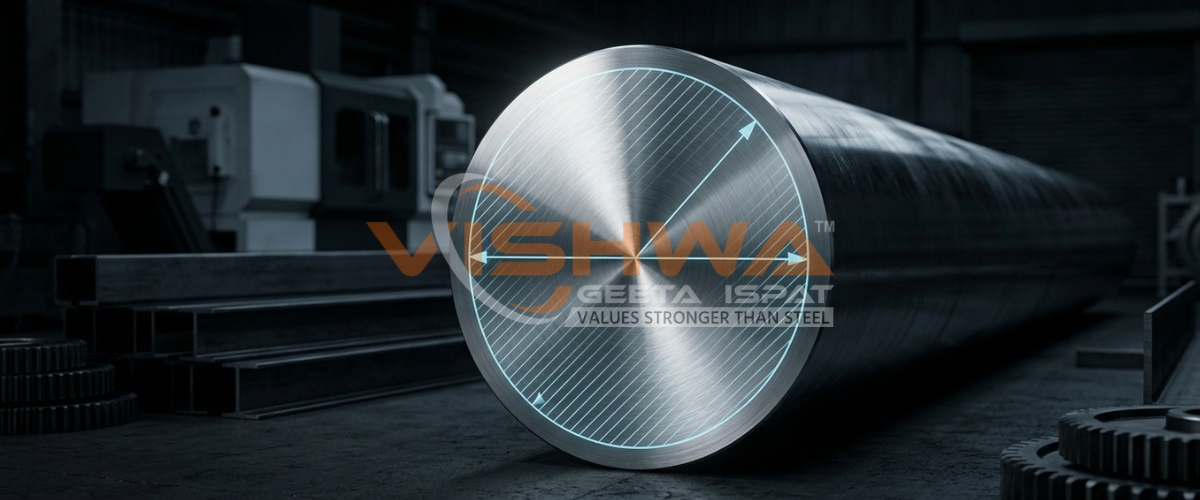
The area of a rod is its cross-sectional area — the circular face you see when you cut the rod perpendicular to its length. One formula drives weight estimation, billing, load capacity, and structural design. This guide covers all of it.
Share diameter, length, and quantity — we'll confirm area, weight per metre, and ₹/kg rate same day.
📋 Send EnquiryFill the contact form 💬 Join WhatsApp ChannelDaily rate updatesArea of a Rod — The Direct Answer
Circular Cross-Section · A = πd²/4 · Result in mm²
Where d is the diameter of the rod in millimetres and A is the cross-sectional area in mm². This applies to any solid circular rod — MS round bar, TMT bar, stainless steel rod, or any cylindrical section. For hollow rods (tubes): A = π(D² − d²)/4 where D is outer and d is inner diameter.
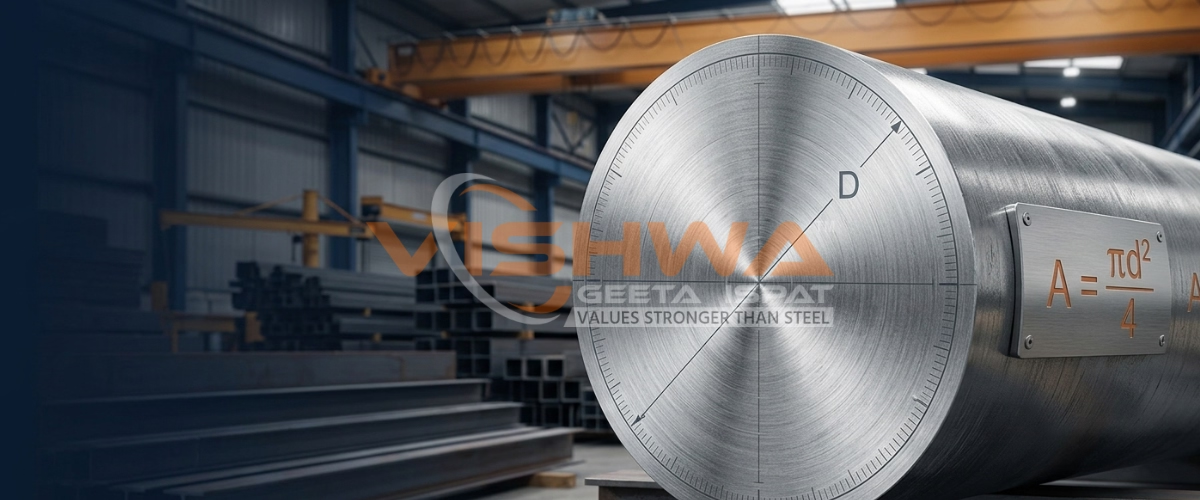
A rod in engineering and construction is a long solid cylindrical member. The phrase "area of a rod" almost always refers to this cross-sectional area — the value that drives weight estimation, procurement billing, load capacity, and structural design calculations. The area does not change along the rod's length (for a uniform section), which makes it the single most useful dimensional property in steel procurement.
The term also has a second unrelated meaning in land measurement: a rod is a US customary unit of length equal to 16.5 feet (5.029 metres), and a square rod = 25.29 m². Both meanings are covered in this guide — the engineering cross-section calculation first, the land unit in Section 8.
How to Calculate the Area of a Rod — Step by Step
Measure · Square · Multiply · Convert
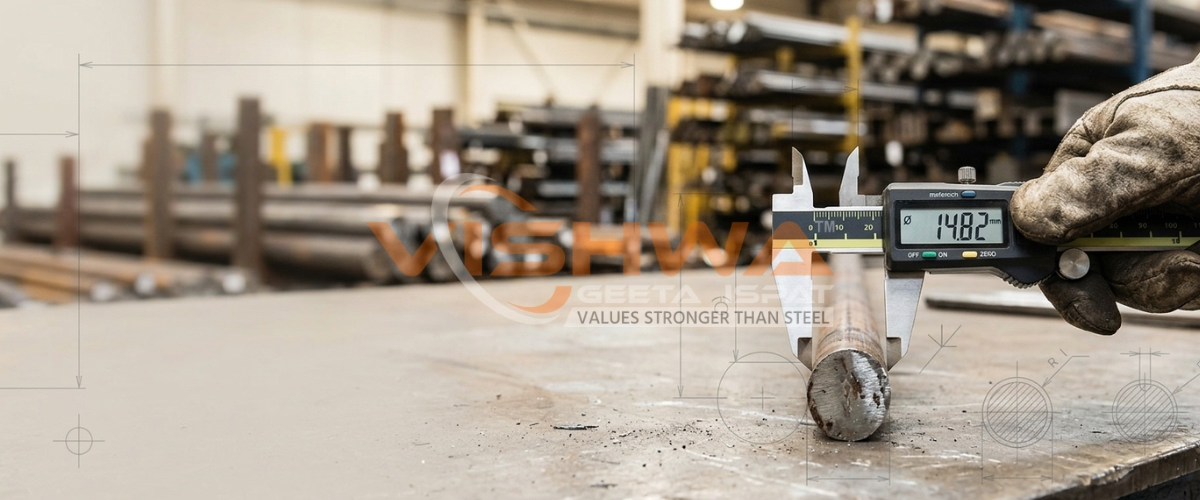
Use a vernier calliper or digital micrometre. Measure across the widest point of the cross-section, perpendicular to the rod axis. For a nominal 25mm rod, the measured value will be close to 25mm (±0.5mm typical rolling tolerance).
Multiply the diameter by itself.
For d = 25mm → 25 × 25 = 625This is π ÷ 4 = 3.14159 ÷ 4. It converts the squared diameter to circular area in mm².
625 × 0.7854 = 490.87 mm²mm² is standard for steel work. To convert: mm² ÷ 100 = cm² · mm² ÷ 1,000,000 = m²
490.87 mm² = 4.9087 cm²Three Worked Examples
A = 0.7854 × 12² = 0.7854 × 144 = 113.10 mm² = 1.131 cm²
A = 0.7854 × 20² = 0.7854 × 400 = 314.16 mm² = 3.142 cm²
A = 0.7854 × 32² = 0.7854 × 1024 = 804.25 mm² = 8.043 cm²
Using diameter in the A = πr² form without halving it first is the single most frequent error. If d = 20mm, then r = 10mm (not 20mm). Using A = π × 20² gives 1,256 mm² — exactly 4× the correct value of 314 mm². To avoid this entirely, use A = 0.7854 × d² where you enter the diameter directly. No halving required.
Rod Area Calculator — Cross-Section, Weight & Cost
Diameter · Length · Pieces · Rate → Area, kg/m, Total MT, ₹ Estimate
MS Round Bar Area & Weight Calculator
Works for any solid circular rod — MS round bar, TMT bar, stainless steel rod, or any circular section.
Area from A = 0.7854 × d². Weight from area × length × steel density (7.85 g/cm³). Cost excludes GST (18%), loading, and freight. Verify with Mill Test Certificate for structural applications.
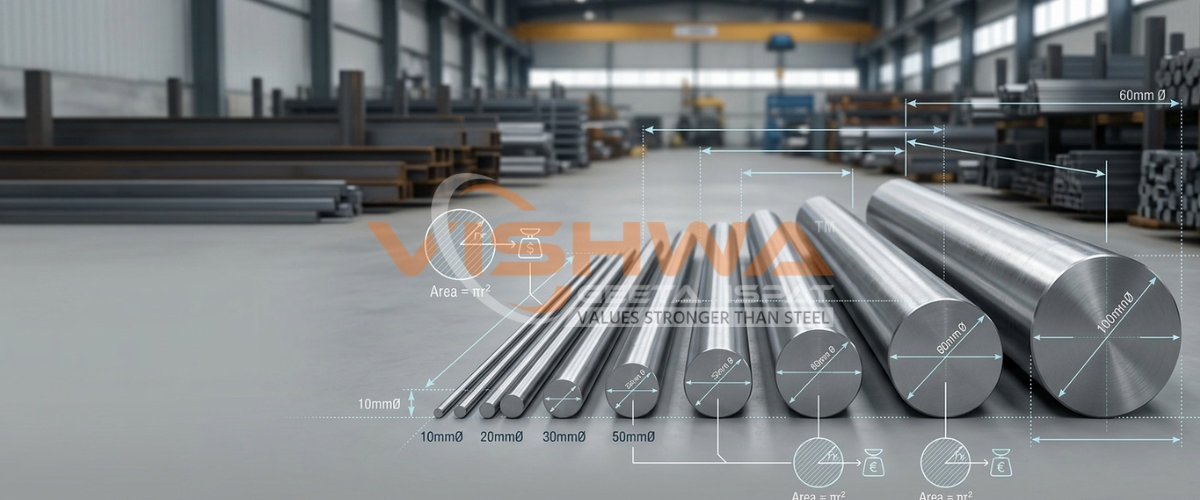
Standard MS Round Bar — Cross-Sectional Area & Weight Table
Diameters 8mm to 100mm · Area in mm² · Weight in kg/m · IS 2062
| Diameter (mm) | Area (mm²) | Area (cm²) | kg/m | kg — 6m bar | kg — 12m bar |
|---|---|---|---|---|---|
| 8 | 50.27 | 0.503 | 0.395 | 2.37 | 4.74 |
| 10 | 78.54 | 0.785 | 0.617 | 3.70 | 7.40 |
| 12 | 113.10 | 1.131 | 0.888 | 5.33 | 10.65 |
| 16 | 201.06 | 2.011 | 1.579 | 9.47 | 18.94 |
| 20 | 314.16 | 3.142 | 2.466 | 14.80 | 29.60 |
| 22 | 380.13 | 3.801 | 2.984 | 17.90 | 35.81 |
| 25 | 490.87 | 4.909 | 3.853 | 23.12 | 46.24 |
| 28 | 615.75 | 6.158 | 4.834 | 29.00 | 58.00 |
| 32 | 804.25 | 8.043 | 6.313 | 37.88 | 75.76 |
| 36 | 1017.88 | 10.179 | 7.990 | 47.94 | 95.88 |
| 40 | 1256.64 | 12.566 | 9.865 | 59.19 | 118.38 |
| 50 | 1963.50 | 19.635 | 15.413 | 92.48 | 184.96 |
| 63 | 3117.24 | 31.172 | 24.470 | 146.82 | 293.64 |
| 75 | 4417.86 | 44.179 | 34.680 | 208.08 | 416.16 |
| 100 | 7853.98 | 78.540 | 61.654 | 369.92 | 739.85 |
| All values from A = 0.7854 × d². Weight = A(cm²) × length(cm) × 0.00785 kg/cm³. Nominal values — actual weight subject to ±2.5% rolling tolerance per IS 1852. For billing and structural work, use MTC-verified weights. | |||||
For quick weight estimation without a calculator, use: Weight (kg/m) = d² ÷ 162, where d is in mm. This comes from 1,000,000 ÷ (π/4 × 7,850) ≈ 162. Example: 25mm rod → 625 ÷ 162 = 3.858 kg/m. This gives results within 0.5% of the exact formula and is universally used in Indian steel trade for rough weight and procurement planning.
From Rod Area to Weight to Cost
Area → Volume → Weight → ₹ — The Full Procurement Chain
Volume = Cross-sectional area × Length in same units
25mm rod, 6m long:490.87 mm² × 6,000 mm = 2,945,220 mm³
Steel density = 0.00000785 kg/mm³
2,945,220 × 0.00000785 = 23.12 kgper bar (25mm × 6m)
Total weight in kg × ₹/kg rate
23.12 kg × ₹58/kg = ₹1,341 per bar(excl. GST and freight)
Why Area Accuracy Matters in Billing
A 1mm diameter error changes the cross-sectional area significantly. Measuring a 25mm rod as 26mm changes the area from 490.87 mm² to 530.93 mm² — an 8% overestimate. On a 10-tonne order at ₹58/kg, that 8% error equals approximately ₹46,400 in billing discrepancy.
Suppliers provide Mill Test Certificates (MTC) confirming actual dimensions. For large orders, physically verify the diameter with a calliper before accepting the consignment, and reconcile any difference between theoretical weight and weighbridge weight before final payment.
Area of a Rod — Other Cross-Section Shapes
Hollow · Square · Rectangular · Hexagonal
Not every rod is solid and circular. The area formula changes with the shape. These are the four most common variants encountered in steel procurement and engineering calculations:
Solid Round Rod
A = 0.7854 × d²The standard case. Used for MS round bars, TMT bars, shafts, fasteners, axles, and tie rods. Diameter is the only input.
Hollow Round Rod (Tube)
A = π(D² − d²) ÷ 4D = outer diameter, d = inner diameter. Used for hollow sections and pneumatic cylinder rods with internal routing.
Square Bar
A = s²s = side length. A 25mm square bar has area 625 mm² — 27% more steel than a 25mm round bar (490.87 mm²).
Hexagonal Rod
A = 0.866 × s²s = across-flats dimension. Used for fastener and tool steel stock. Area is 86.6% of the bounding square.
Rod Area in Pneumatic Cylinder Applications
Retract Force · Annular Area · Double-Acting Cylinders
In pneumatic and hydraulic engineering, the cross-sectional area of a piston rod directly affects the force produced on the return (retract) stroke of a double-acting cylinder. This is one of the most frequently miscalculated parameters in pneumatic system design.
Why Rod Area Changes the Force Equation
In a double-acting cylinder, the extend stroke uses the full piston face area. The retract stroke uses only the annular area — piston area minus rod's cross-sectional area — because the rod displaces part of the piston face.
Extend Force = Pressure × Piston Area
Retract Force = Pressure × (Piston Area − Rod Area)
Worked example — 63mm bore, 20mm rod, 6 bar:
- Piston area = 0.7854 × 63² = 3,117 mm²
- Rod area = 0.7854 × 20² = 314 mm²
- Net retract area = 3,117 − 314 = 2,803 mm²
- Extend force = 6 × 3,117 = 18,702 N
- Retract force = 6 × 2,803 = 16,818 N (10.1% lower)
Standard Rod Area Reference Table
| Rod dia | Rod area (mm²) | Force reduction @ 6 bar |
|---|---|---|
| 8mm | 50.3 | 302 N |
| 12mm | 113.1 | 679 N |
| 16mm | 201.1 | 1,207 N |
| 20mm | 314.2 | 1,885 N |
| 25mm | 490.9 | 2,945 N |
| 32mm | 804.2 | 4,825 N |
Force reduction = Rod Area × Operating Pressure. Standard design rule: rod diameter = 0.5 × bore diameter gives ~25% lower retract force than extend force.
Fig 6 — In a double-acting cylinder, retract force uses the annular area (piston area − rod area). Attach pneumatic cylinder diagram here.
Designing a pneumatic system for extend force only and ignoring the retract area reduction is one of the most common causes of return-stroke failure in industrial automation. For cylinders with rod-to-bore ratios of 0.6 or higher, retract force is 36% lower than extend force — enough to stall the mechanism under load if not accounted for in cylinder sizing.
Rod as a Unit of Land Area
US Customary · 16.5 Feet · 5.029 Metres · Square Rod = 25.29 m²
In the US customary system, a rod (also called perch or pole) is a unit of length, not a cross-sectional area. It is defined as:
- 1 rod = 16.5 feet
- 1 rod = 5.0292 metres
- 1 square rod = 25.2928 m²
- 1 square rod = 272.25 square feet
- 160 square rods = 1 acre (43,560 ft²)
A traditional acre is the rectangular area of 40 × 4 rods (or 66 × 660 feet). Land surveyors and older property documents in the USA still use rods and square rods, particularly in rural and agricultural contexts.
This definition of "rod" is entirely unrelated to the cylindrical engineering rod. When the search context is land measurement or surveying, the square rod conversion applies. When the context is structural steel, construction, or engineering, the circular cross-section formula A = πd²/4 is what is needed.
Square Rod Conversion Table
| Measure | Equivalent |
|---|---|
| 1 rod (length) | 5.0292 metres = 16.5 feet |
| 1 square rod | 25.2928 m² |
| 1 square rod | 272.25 sq ft |
| 1 square rod | 30.25 sq yards |
| 160 square rods | 1 acre (43,560 sq ft) |
| 1 acre | 40 × 4 rod rectangle |
Frequently Asked Questions
Area of a Rod — Formula, Calculation & Applications
Vishwageeta Ispat — Raipur, Chhattisgarh
Vishwageeta Ispat is Raipur's trusted iron and steel supplier — stocking MS round bars, TMT bars, MS angles, H-beams, I-beams, channels, pipes, and all structural steel products. We provide IS-standard weight references, mill test certificates on request, and competitive delivered rates across Chhattisgarh and Central India.
Need MS round bars? Share diameter, length, and quantity — we'll confirm cross-sectional area, weight per metre, current ₹/kg rate, and dispatch timeline same working day.