A Closer Look at the Many
Electric Pole Types
That Hold the Network Together
An electric pole looks simple from a distance, yet it carries major responsibility in every power corridor. It supports conductors, keeps safe ground clearance, and helps utilities maintain stable distribution through heat, rain, and wind. Buyers should not treat it as a basic commodity item.
Share application, height, voltage class, and quantity — we'll confirm the right pole type, weight, and ₹/piece rate same day.
📋 Send EnquiryFill the contact form 💬 Join WhatsApp ChannelDaily rate updatesWhy Choosing the Right Electric Pole Type Decides Project Outcomes
Application Match · Life-Cycle Cost · Specification-First Buying
An electric pole looks simple from a distance, yet it carries major responsibility in every power corridor. It supports conductors, maintains safe ground clearance, and helps utilities deliver stable distribution through heat, rain, and wind. Therefore, buyers should not treat the pole as a basic commodity item — they should choose by application, load condition, life-cycle cost, and installation environment.
In practice, failures happen when selection is rushed. An under-sized unit may survive initial commissioning but begin to lean once cable load and seasonal wind pressure increase. Poor coating or improper curing can shorten service life by 30–40% before the buyer even realises why repair frequency has increased. A structured buying approach is far more useful than price-only comparison — and the difference between the right pole type and the wrong one usually shows in the third or fourth year of service, not on the dispatch challan.
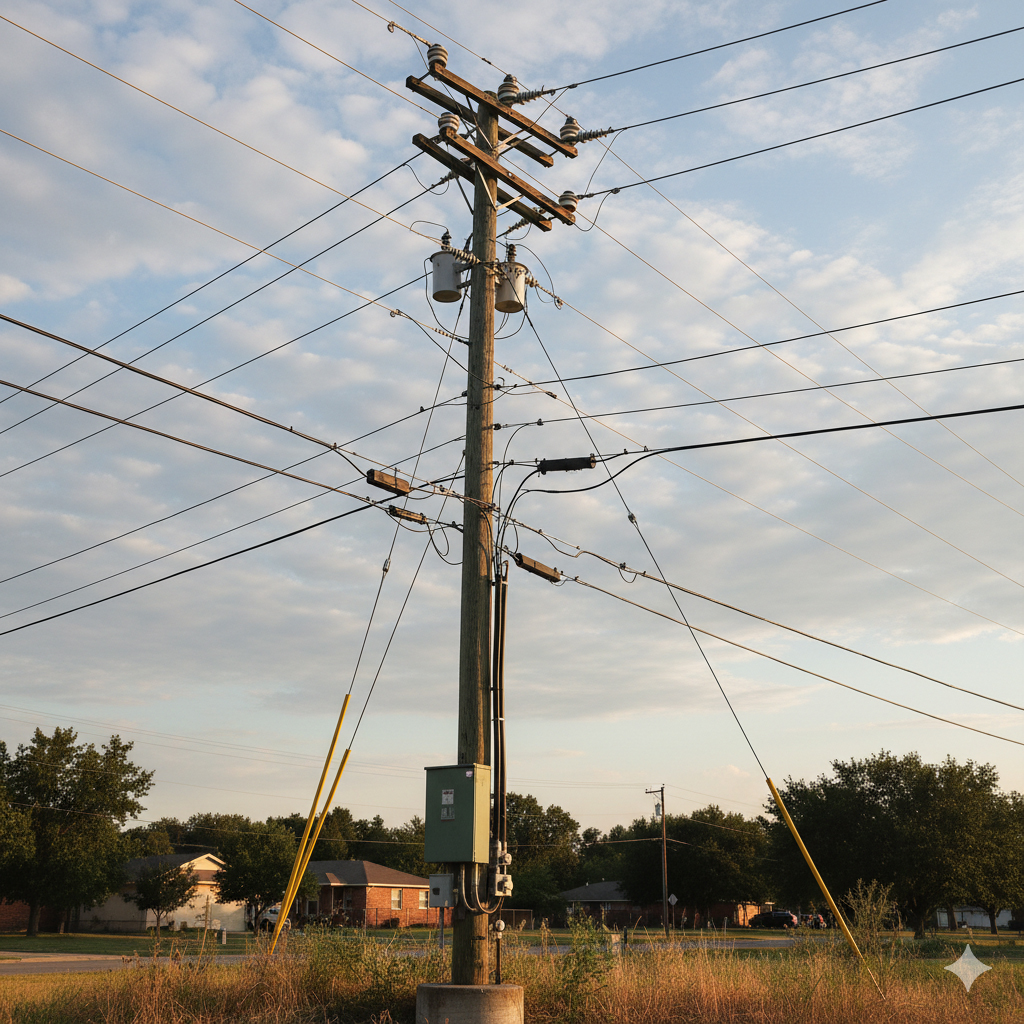
Electric Pole Basics for Buyers and Site Teams
Use Case · Expected Load · Maintenance Access · Civil-Electrical Coordination
Before placing a purchase order, confirm three fundamentals: use case, expected load, and maintenance access. First, define whether the line is for street lighting, local distribution, industrial service, or long-distance transmission — each calls for a different pole type. Next, map total hardware weight including conductors, brackets, insulators, and any future add-ons (CCTV, telecom, smart-city sensors). Finally, check whether replacement or repair work can be safely done after installation — a pole installed in a constrained location with no equipment access is significantly harder to maintain over a 25-year service life.
When civil-electrical coordination is delayed, foundation dimensions and mounting accessories often mismatch. As a result, project delays and rework costs rise quickly. The most common rework cause is foundation pit dimensions cast for one pole base diameter and the actual delivered pole having a different base — discovered only at erection day.
Materials You Can Choose for Long Service Life
Concrete · Steel · Hybrid · Project-Specific Selection
Concrete
Strong weather resistance, reliable long-term stiffness, and lower corrosion risk in exposed zones. Heavier transport and lifting logistics — plan in advance for narrow or congested streets.
Steel (RSJ / Tubular)
Cleaner geometry, easier transport, and flexible fabrication for custom fittings and attachments. Coating quality is critical — without good galvanisation, durability drops in humid and polluted environments.
Hybrid / Project Specific
Used where multi-utility mounting or phased network upgrades need special design integration. Tailored to specific project requirements with documented load analysis.
Concrete Pole — Where It Performs Best
A concrete electric pole performs well where long service life and low rust risk are priorities. It is rigid, dimensionally stable, and does not require coating maintenance. However, because it is heavier than steel of equivalent strength, site handling and lifting logistics must be planned in advance. In narrow streets or congested colonies, transport route checks become especially important — a 200kg concrete pole that cannot be brought to the installation point because of road width is functionally useless regardless of its specification.
Steel Pole — Where It Performs Best
Steel electric pole variants are easier to move and faster to position in many urban projects. They can be fabricated for specific bracket layouts, including pre-drilled mounting points for CCTV, lighting arms, and telecom accessories. Still, coating quality is the single most important specification parameter for steel poles. Without a proper galvanising or surface treatment system, durability drops sharply in humid, coastal, or industrially polluted environments — sometimes by 50% compared to a properly coated equivalent.
Height, Clearance Planning, and Pre-Order Load & Foundation Checks
Sag Allowance · Wind Zone · Soil Condition · Future Margin
Height and Clearance Planning
Correct height is a safety requirement, not a cosmetic choice. If clearance is too low, conductors may sag into hazardous zones during hot weather when thermal expansion is at maximum. On the other hand, excessive height increases bending moment and foundation stress without improving service.
The best design balances span length, thermal sag allowance, traffic movement, and local wind pattern simultaneously. Future growth should be considered too — if roads are expected to widen or buildings are likely to rise, plan additional safety margin at the design stage. This prevents costly relocation and re-stringing later.
The clearance that must be maintained is at maximum operating temperature — typically a summer afternoon — not at the ambient temperature when the line was strung. A clearance check that ignores thermal sag produces a line which fails the same check every summer.
Pre-Order Checklist Items
Every project should run a basic pre-order checklist for electric pole procurement:
- Conductor and accessory load summary: present plus reasonable future additions
- Wind zone and terrain exposure: validate against IS 875 design wind speed for the location
- Soil condition and foundation depth: confirmed with site investigation, not assumed
- Corrosion class and coating requirement: defined per environment (urban / coastal / industrial)
- Dispatch sequence: mapped to civil and erection readiness on site
- Accessory inclusion: base plate, crossarms, stay rods specified or excluded clearly
When these checks are documented upfront, procurement becomes more accurate, supplier comparison becomes meaningful, and delivery planning becomes smoother.
Electric Pole Types by Application — Match Pole to Job
Distribution · Street Lighting · Industrial · High-Voltage · Special Purpose
Different jobs need different structures. A residential lane, an industrial feeder, and a high-voltage corridor cannot use the same standard pole profile without trade-offs that compromise either cost or safety. Application-based classification helps procurement teams avoid overdesign in one area and underdesign in another.
Distribution Poles
For residential and commercial LT networks. Moderate height (8–9m), consistent spacing, and quick service access. Uniform appearance is also important for city roads.
Street Lighting Poles
Dedicated to road and colony illumination. Height matched to road width, lamp arm geometry tuned to lighting calculation, often combined with smart-city accessories.
Industrial Feeder Poles
For factory and warehouse supply. Heavier sections, deeper foundations, designed for higher current loads and the vibration profile of industrial movement.
High-Voltage Corridor Poles
For HT transmission connecting substations and towns. Stronger sections, larger clearances, tighter alignment control. A small design mismatch affects long line stretches.
Special Purpose Poles
Tension turns, dead-end terminations, river or road crossings. Heavier than standard poles in the same line; designed for the specific lateral load they will carry.
Distribution and Street Lighting Networks
These routes usually need moderate heights, consistent pole-to-pole spacing, and quick service access for routine maintenance and accessory additions. Visual uniformity matters more than people realise — a distribution route with mixed pole heights and styles looks unmaintained even when each pole is structurally sound. Consistency in procurement specification across an entire route or colony improves both operational reliability and visible quality.
High-Voltage Corridors and the Electric Pole
Transmission environments demand stronger structural sections, larger ground and crossing clearances, and tighter alignment control across long line stretches. Even a small design mismatch — a single wrong pole in a long row — can affect the reliability of an entire transmission line. The cost of getting transmission pole specification wrong is significantly higher than for distribution: failures take longer to diagnose, downtime affects more consumers, and emergency repair on energised HT lines is operationally complex and expensive.
Procurement Checklist for Price and Quality Comparison
Material Grade · Coating · Tolerance · Commercial Terms · Dispatch Support
Price variation is normal in this category. However, smart buyers compare total delivered value, not just ex-yard rate. Use the checklist below when finalising electric pole suppliers:
| Parameter | What to Ask | Why It Matters |
|---|---|---|
| Material Grade | Steel grade certificate, concrete mix design, test references | Controls structural reliability and overall service life |
| Coating / Finish | Galvanisation thickness in microns, paint specification, DFT | Determines corrosion resistance over 15–25 years |
| Dimensional Accuracy | Tolerance declaration on length, base diameter, taper | Reduces fitment rework at the installation site |
| Accessory Inclusion | Base plate, crossarms, stay assemblies — included or extra? | Avoids cost surprises and incompatible mixed sourcing |
| Commercial Terms | Freight, unloading, taxes, payment cycle, warranty scope | Avoids hidden cost surprises during dispatch and after |
| Dispatch Support | Lead time per phase, sequence planning, document scope | Keeps project timeline on track during phased erection |
A pole quote that is 15% cheaper than market may carry one of these hidden compromises: thinner steel section, lower-grade galvanising, missing accessories that must be purchased separately, longer lead time that delays project commissioning, or weaker commercial terms with higher payment risk. Compare delivered total value with documented specifications — not just headline rate per piece.
How Vishwageeta Ispat Supports Reliable Electric Pole Project Supply
Specification Alignment · Phase-Wise Dispatch · Documentation · Coordination
Vishwageeta Ispat works with a practical, execution-first approach. The team helps buyers align product choice with site conditions, lead times, and project phase planning. As a result, procurement decisions become easier and more predictable across the project lifecycle.
Whether the requirement is for utility distribution, structural support, street lighting, or project-based phased dispatch, the emphasis remains the same: dependable quality, clear documentation, and timely delivery coordination matched to the civil and erection schedule on the ground.
What Project Buyers Get
- Specification-aligned electric pole selection based on actual project conditions
- Confirmed IS-standard dimensions and section weights before order
- Coating and finish documentation as part of dispatch records
- Phase-wise dispatch matched to civil foundation readiness
- Same-day rate confirmation on quantity and delivery enquiries
- Direct communication channel via WhatsApp and contact form
Final 7-Point Checklist Before Confirming Any Electric Pole Order
From Specification to Dispatch
- Define use case clearly: distribution, street lighting, industrial feeder, transmission, or special-purpose. Each calls for a different pole type, height, and section specification.
- Confirm material with environment: steel for urban smart-city and multi-attachment use, concrete for stable rural networks. Coating spec for steel always documented.
- Validate height for maximum thermal sag clearance: not just installation-day clearance. Account for IS 5613 minimums by voltage and crossing type.
- Run pre-order load and wind check: conductor weight, accessory weight, design wind speed for the zone. Documented before procurement.
- Compare suppliers on delivered total value: material grade, coating thickness, accessories included, dispatch terms — not just ex-yard rate per piece.
- Plan phase-wise dispatch: match delivery quantity per phase to civil foundation and erection readiness. Avoid bulk delivery that causes site storage issues.
- Document everything in the PO: grade certificate scope, coating specification, dimensional tolerance, accessory inclusion, dispatch sequence, payment terms.
Frequently Asked Questions
Electric Pole Types — Materials, Selection & Procurement
Vishwageeta Ispat — Raipur, Chhattisgarh
Vishwageeta Ispat is Raipur's trusted iron and steel supplier — manufacturing and supplying RSJ electric poles across all standard application types: distribution, street lighting, industrial feeders, and transmission. We supply with confirmed IS specifications, documented coating systems, and competitive delivered rates across Chhattisgarh and Central India.
Need the right electric pole type for your specific project? Share application, voltage class, height, quantity, and delivery location — we'll confirm pole type, weight per piece, current ₹/piece rate, and dispatch timeline same working day.