The Everyday Existence
of a Utility Pole
That Disappears in Routine
A utility pole stands through day and night carrying electricity, telecom, broadband, CCTV, and public lighting. Most people walk past as if it is part of the background — until something shifts.
Share pole height, load requirement, and quantity — we'll confirm section, weight, and ₹/piece rate same day.
📋 Send EnquiryFill the contact form 💬 Join WhatsApp ChannelDaily rate updatesThe Utility Pole That Almost Disappears in Daily Routine
Electric Utility Pole · Overhead Infrastructure · Silent Load Bearer
A utility pole stands through day and night, yet most people walk past as if it is part of the background. It carries electricity wires, phone lines, broadband cables, CCTV boxes, and public lighting connections — often simultaneously. Still, public attention usually comes only when something shifts: a visible lean, a lower wire, or a service interruption that suddenly makes the pole impossible to ignore.
The job appears straightforward from the outside, but nothing about a utility pole's real performance is simple. It keeps high-voltage lines elevated and safely separated from ground level. It maintains conductor alignment and controlled tension from one pole to the next. It handles wind load, cable weight, temperature cycles, and vibrations caused by long-distance power transmission — all at the same time, without any visible effort.
The Unexpected Engineering Complexity Behind a Pole That Looks Simple
Height Calculation · Load Capacity · Wind Resistance · Alignment
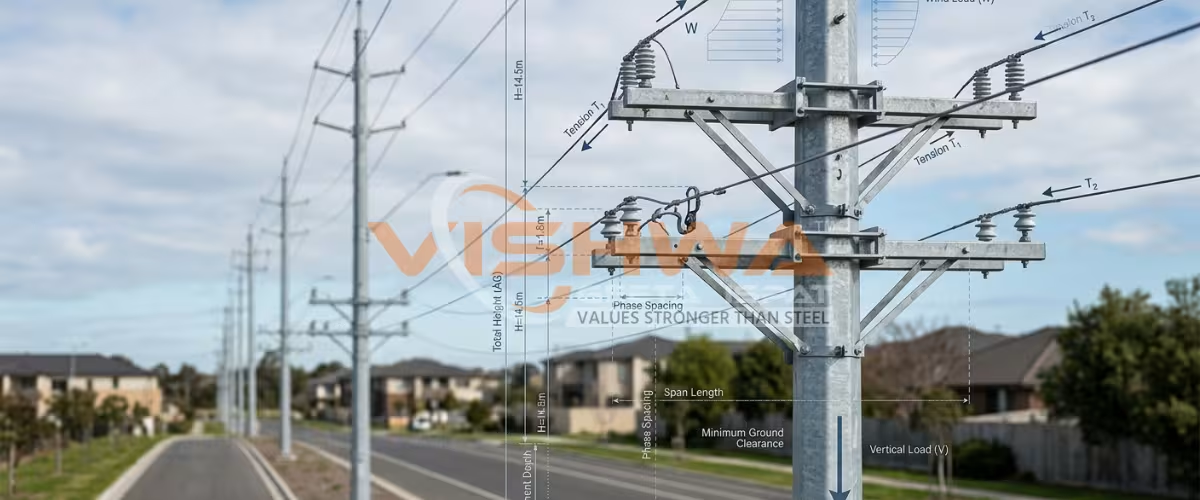
A utility pole is not just a vertical member placed in soil. Its real performance depends on height calculation, load capacity, soil behaviour, pole-to-pole distance, and wind resistance. Every one of these choices interacts with the others. A small installation angle error may not fail immediately, but it can start a chain of minor issues that appear season by season — making root-cause diagnosis much harder to trace back to the original mistake.
Height selection is a calculated trade-off, not a standard default. Too tall and the base bending moment increases under wind load. Too short and the conductors fail minimum ground clearance requirements when they sag thermally in summer. The correct height satisfies clearance at maximum sag, withstands wind at maximum gust speed, and keeps the base section within the pole's structural capacity — all at once.
Spacing between poles must account for conductor catenary shape, sag under maximum temperature, wind load on the conductors, and the tension limits of the conductor material. One incorrectly spaced span propagates tension imbalance into adjacent spans, increasing maintenance requirements across the entire route section.
A single pole installed 3 degrees off vertical changes the bending moment distribution at its base. Under repeated wind load cycles, this creates micro-fatigue at the soil-pole interface. Over 5–8 years, the same pole shows visible lean — with no obvious installation defect visible above ground. The error was in the installation angle, not the pole itself.
In a typical urban distribution setup, a single utility pole may simultaneously carry: 1–2 HT conductors, 3–4 LT conductors, broadband/fibre cables, a street light arm, CCTV bracket, and telecom aerial cables. The combined weight and wind drag on all of these can be 3–5× the original single-purpose design load.
Why Pole Material Changes the Entire Life-Cycle
Wood · Concrete · Steel RSJ · Fibre Composite · Maintenance Cost
Different geographies, load requirements, and maintenance budgets call for different pole materials. The choice made at procurement determines not just the upfront cost, but the inspection regime, failure mode, and total cost of ownership over 20–30 years.
| Material | Typical Advantage | Long-Term Caution | Best For |
|---|---|---|---|
| Wood | Legacy compatibility; low initial cost | Moisture and insect deterioration without regular treatment | Rural LT lines, temporary networks |
| Prestressed Concrete | Rigid, low corrosion, widely available | Internal cracking can spread before becoming surface-visible | Rural and semi-urban LT distribution |
| Steel RSJ | High load capacity, light transport, visual inspection | Needs protective coating; corrosion at soil-air interface | Urban networks, HT lines, multi-attachment poles |
| Fibre Composite | Lightweight, corrosion-resistant | Surface damage during incorrect installation reduces long-term strength | Coastal, high-humidity, chemical exposure zones |

How a Utility Pole Gets Overloaded — and How Weather Weakens It Silently
Unauthorised Attachments · Cumulative Wind Drag · Thermal Fatigue · Corrosion
Overloading Without Anyone Realising
A utility pole rarely stays with one purpose. It may start with power lines, then telecom lines are added, followed by CCTV, festival fixtures, banners, and other local attachments. Each item seems small in isolation, but cumulative load and wind drag can significantly alter the stability margin — often without any single person having authorised or reviewed the total change.
During inspections, overloaded poles are commonly found where unplanned additions have clearly accumulated over time. The visible result — a gradual lean, stressed stay wires, or a cracked concrete base — is the outcome of many small decisions, none of which appeared consequential individually.
Three broadband cables + one CCTV camera + two festival banner wires may each seem trivial in isolation. Together they can add 40–60 kg of dead load and increase wind-exposed area by 30–50%. On a pole already at 80% of its design capacity, this pushes the total load beyond safe limits — without anyone having made a single obviously irresponsible decision.
What Weather Does Over the Years
Weather does not usually break a utility pole in a single event. It weakens it gradually and silently:
- Sun: thermal expansion and contraction cycles create micro-fatigue at connection points and crossarm bolts
- Rain: softens soil around the base, allowing slight rocking under wind load — which progressively widens the foundation hole
- Wind: repeated lateral pressure over years accumulates fatigue at the base section, even when no single storm causes visible damage
- Coastal salt / industrial pollution: accelerates corrosion on uncoated or inadequately coated steel sections by 3–5×
- Agricultural moisture: persistent damp soil elevates the corrosion rate at the critical soil-air interface on steel poles
No single factor looks critical in isolation. Together they reduce service life significantly — often reaching structural inadequacy 5–10 years before the scheduled replacement cycle.
The Real Strength of a Utility Pole Is Mostly Below Ground
Soil Bearing · Embedment Depth · Compaction · Waterlogging · Rocky Ground
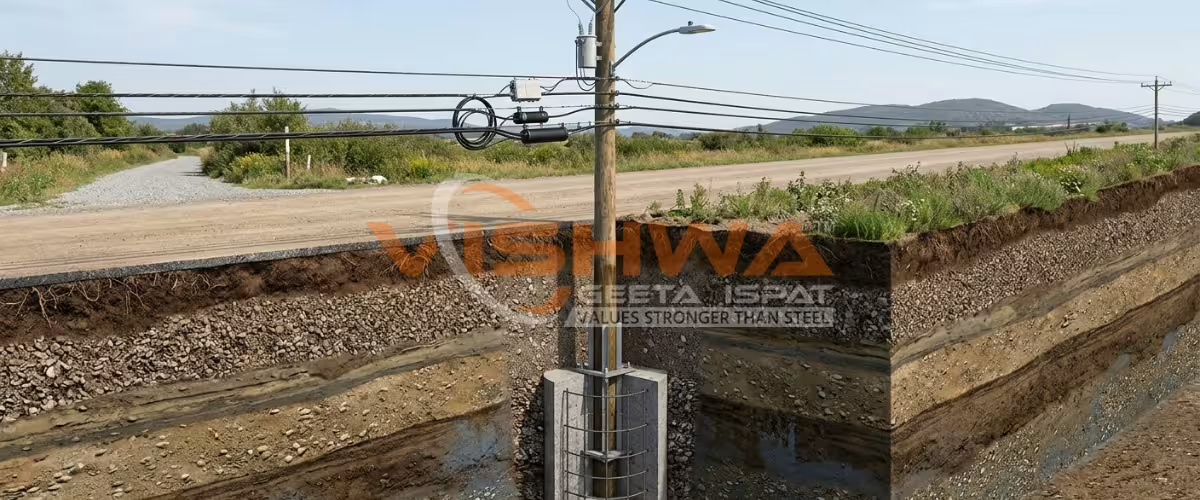
The visible upper portion of a utility pole gets all the attention. The part that decides long-term stability is buried inside the soil. Loose or waterlogged soil needs greater embedment depth to develop adequate lateral resistance. Rocky terrain needs precise drilling — otherwise the stress concentration around the pole base causes cracking in concrete sections or accelerated corrosion in steel at the rock-soil interface. Water-heavy zones need drainage consideration to prevent progressive tilt after each monsoon.
If the foundation is weak, failure tends to be silent and progressive rather than sudden. The pole leans a fraction of a degree each monsoon season. By the time the lean is visible from the road, the foundation has typically been compromised for 2–4 years — and the conductor clearance may already be below specification under maximum sag conditions.
This is why foundation depth and soil preparation receive the same engineering attention as pole section selection in a properly designed distribution line. A strong pole section on a weak base still fails — the timeline is just slower than for an under-specified pole on adequate ground.
Foundation Depth Guidelines
- Standard LT poles (8–9m): minimum embedment = pole height ÷ 6, minimum 1.5m
- HT and tension poles: deeper embedment required — calculate from lateral design load
- Soft / waterlogged soil: increase depth or use concrete surround
- Rocky ground: drill precisely, seal annular gap with cement grout
- Backfill: well-compacted granular material — never loose excavated soil
- Post-monsoon check: inspect for base settlement or gap formation around pole
Why Spacing Is Never Random — and Why Urban and Rural Poles Face Different Pressures
Span Engineering · Sag Calculation · Urban Load Density · Rural Wind Exposure
Spacing Is Always Engineered
Look at any utility line. The distance between poles looks routine, but it is the result of specific calculations. Excess spacing causes conductors to sag below minimum ground clearance under maximum temperature conditions. Too little spacing creates excessive line tension and elevates snapping risk during sudden temperature drops or wind gusts.
A single spacing mistake in one stretch forces adjustments in the next few spans — creating unequal tension, non-uniform sag, and higher maintenance frequency across the affected route section. Correct spacing is a network-level design decision, not a field measurement made by the installation crew.
A span 15% longer than design causes the conductor to sag below clearance at maximum temperature. To compensate: the next pole must be taller, or the span shortened, or the conductor re-tensioned. Each correction creates requirements that propagate into adjacent spans. This is why span decisions belong at the route design stage.
Urban vs Non-Urban Stress Environments
Urban poles and rural poles carry structurally similar sections, but face fundamentally different dominant stress mechanisms:
Urban Poles
Higher cable density, traffic vibration, frequent accessory attachments, and shorter inspection intervals. Foundation disturbed by nearby construction and utility excavation.
Rural Poles
Longer unshielded spans, stronger open-wind exposure, larger seasonal temperature swings, and less frequent inspection. Agricultural moisture accelerates base corrosion.
The core function is similar, but the dominant degradation mechanism is different in each context — which is why a one-size-fits-all maintenance schedule produces under-maintained rural poles and over-specified urban replacements simultaneously.
From Electricity Carrier to Data Carrier — and the Smart-City Future
Fibre · Broadband · 4G/5G · Smart Lighting · Sensor Hub

The Pole as a Data Node
Traditionally, a utility pole was viewed as power infrastructure. Today, communication lines frequently dominate its total load profile: fibre optic bundles, broadband aerial cables, telephony, surveillance CCTV, and connected public systems. In many urban installations, data cables now outnumber power conductors on the same pole.
One damaged utility pole can therefore disrupt power and digital continuity simultaneously — affecting internet access, digital payments, business operations, and emergency communication systems in the immediate area. The infrastructure is no longer single-utility; it is hybrid, and its failure consequence is proportionally broader.
The Smart-City Future Load
As cities adopt smart systems, individual poles are expected to carry: smart lighting controllers, emergency public address speakers, environmental air quality sensors, traffic monitoring cameras, 4G/5G small-cell antennas, and in some projects, EV charging management equipment.
Utility poles are becoming multi-service support assets — not just wires-in-the-air supports. Vishwageeta designs poles keeping future capacity in mind, because retrofitting structural upgrades to an installed pole network is significantly more expensive and disruptive than specifying adequate capacity from the beginning.
A pole specified today for a smart city project should account for a 10-year attachment profile — not just the day-one load. Specifying section size and foundation depth for the anticipated maximum future load prevents mid-lifecycle structural inadequacy without requiring full pole replacement.
Practical Checklist for Utility Pole Installation or Inspection
6 Points That Prevent the Most Common Long-Term Failures
- Confirm total planned load including future attachments: design for the 10-year attachment profile — power conductors, telecom, lighting, sensors — not just the day-one load.
- Verify ground clearance under maximum sag conditions: conductor sag at maximum operating temperature, not just ambient installation conditions. IS 5613 provides the clearance minimums by voltage level and crossing type.
- Assess soil condition before installation: bearing capacity, drainage, groundwater level. Use concrete surround or increased depth for soft, waterlogged, or disturbed soil.
- Confirm span layout from route design calculations: spacing from conductor weight, design wind speed, sag limit, and clearance requirement — not field convenience.
- Plan corrosion protection for steel poles: zinc-rich primer and finish coat at installation; 5–7 year inspection and touch-up cycle in normal environments, 2–3 years in coastal or industrial areas.
- Schedule post-monsoon alignment checks: inspect for lean, foundation gap formation, and unauthorised attachment accumulation. Early intervention costs a fraction of post-failure remediation.
Frequently Asked Questions
Utility Pole — Load, Foundation, Spacing & Future
Vishwageeta Ispat — Raipur, Chhattisgarh
Vishwageeta Ispat is Raipur's trusted iron and steel supplier — manufacturing and supplying RSJ electric poles, MS sections, TMT bars, structural steel, and all utility steel products across Chhattisgarh and Central India. We supply with confirmed IS specifications and competitive delivered rates.
Need utility-grade RSJ poles for distribution, street lighting, or smart city projects? Share pole height, load requirement, and quantity — we'll confirm section size, weight, current ₹/piece rate, and dispatch timeline same working day.