The Everyday Steel Shape
That Does More Work
Than Most People Notice
The H beam sits inside buildings, bridges, warehouses, towers, and heavy structures — quietly holding massive loads without drama. Its strength comes from smart geometry, quality steel, and correct sizing. This guide explains all three.
Share section size, quantity, and delivery location — we'll confirm dimensions, kg/m, and ₹/kg rate same day.
📋 Send EnquiryFill the contact form 💬 Join WhatsApp ChannelDaily rate updatesWhat an H Beam Actually Is — and Why It Matters
H Section · Wide Flange · ISHB Series · IS 808
The H beam is one of those structural steel sections that doesn't get much attention outside construction or fabrication. It sits inside buildings, bridges, warehouses, towers, and heavy structures — quietly holding massive loads without drama. Most people never realise that a simple H-shaped steel section can carry tonnes of weight every day, year after year, without visible signs of effort.
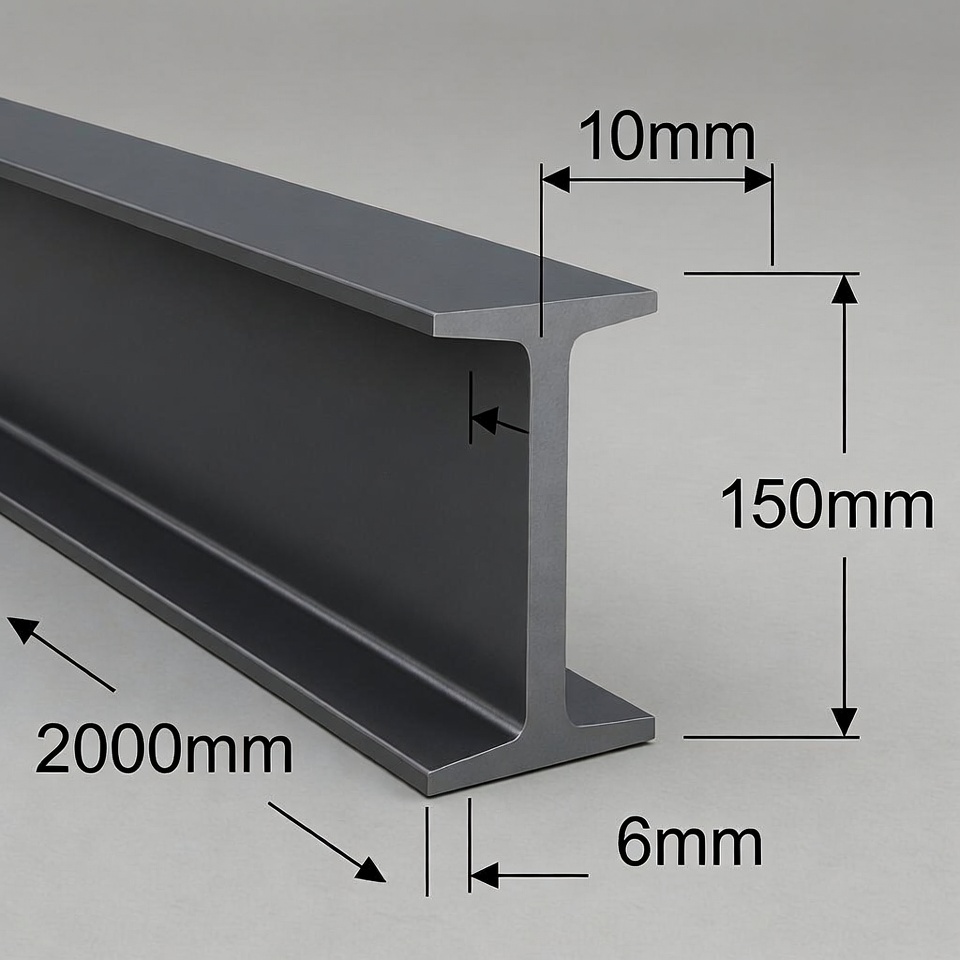
The H beam takes its name from its cross-sectional shape: two wide horizontal plates (flanges) connected by a vertical plate (web). In India, the standard series is ISHB (Indian Standard Heavy Beam), produced to IS 808 by mills including SAIL and JSPL. The same geometry is called a wide-flange section or W-section in international standards.
Why the H Beam Was Designed With Such a Simple Shape
Flanges · Web · Bending Resistance · Shear Capacity
At first glance, the cross-section looks almost too simple: two wide flanges and a central web connecting them. But that simplicity is exactly why the H beam works as well as it does.
The flat flanges handle compression and tension — the top flange under compression, the bottom flange under tension when the beam bends. The web between them controls shear and prevents the section from collapsing under transverse forces. Together, they create a geometry where most of the steel is placed as far from the neutral axis as possible — maximising the moment of inertia, and therefore the beam's bending resistance, relative to its weight.
Engineers choose this shape because it distributes load efficiently across the beam length. The beam stays stable under heavy floors, long spans, dynamic loads, and changing conditions — all without requiring excessive steel mass.
Bending resistance (moment of inertia) scales with the cube of section depth. By placing flanges at maximum distance from the centre — with a relatively light web connecting them — the H beam achieves high stiffness for its weight. This is why deepening the section by 25% can more than double its bending resistance.

How Material Quality of an H Beam Decides the Future of a Building
Steel Grade · IS 2062 · E250 · E350 · Mill Test Certificate
An H beam is not just steel pressed into a shape. Steel grade, alloy composition, dimensional accuracy, rolling temperature, and heat treatment influence final strength and ductility in ways that are not visible to the eye after the beam is fabricated and painted.
Poor-quality steel can show deformation, micro-cracking, or unexpected ductility loss under repeated dynamic stress — the kind that cranes, heavy vehicles, or wind loading apply constantly over decades. In structural work, one under-specified beam hidden inside a building can create uneven load distribution that increases stress in adjacent members year after year.
| Grade (IS 2062) | Min. Yield Strength | Min. Tensile Strength | Typical Use |
|---|---|---|---|
| E250 (Fe 410) | 250 N/mm² | 410 N/mm² | Standard structural applications, sheds, general fabrication |
| E350 (Fe 490) | 350 N/mm² | 490 N/mm² | High-load columns, crane bays, multi-storey frames, bridges |
For any structural H beam order — especially for crane bays, multi-storey frames, bridges, or seismic zones — request a Mill Test Certificate (MTC) confirming grade, heat number, chemical composition, and mechanical test results. This is the only document that proves the beam meets the specified grade. Visual inspection cannot substitute for an MTC.
Height, Width and Thickness — Not Random Numbers
Depth H · Flange Width B · Web Thickness tw · Flange Thickness tf
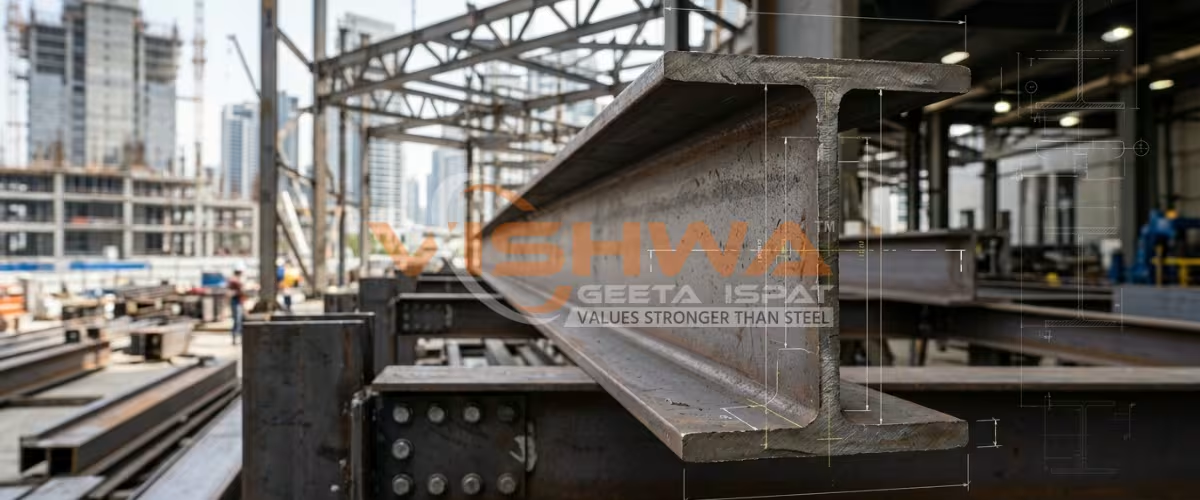
Many buyers assume H beams come in interchangeable "standard sizes" and that selection is straightforward. In reality, every millimetre in flange width or web thickness affects strength, stability, and span performance in ways that are measurable and structurally significant.
| Dimension | What It Controls | Structural Effect | Site Impact |
|---|---|---|---|
| Section depth (H) | Major-axis bending resistance | Scales with depth³ — small depth increases give large stiffness gains | Governs maximum economical span length |
| Flange width (B) | Lateral stability, minor-axis stiffness | Wide flanges resist lateral torsional buckling; better for columns | Critical in column applications and wind/seismic zones |
| Web thickness (tw) | Shear capacity, local stability | Governs shear resistance at supports and under concentrated loads | Thicker webs reduce need for stiffener plates at connections |
| Flange thickness (tf) | Bending capacity, weld size | Contributes directly to section modulus; governs weld leg size | Determines connection plate and end plate geometry |
ISHB 250 and ISHB 250(1) have the same 250mm depth and the same 250mm flange width, but different web and flange thicknesses. ISHB 250 weighs 51.0 kg/m; ISHB 250(1) weighs 61.3 kg/m — 20% heavier with higher bending capacity. Ordering the wrong sub-series is a structural error, not a minor weight difference. Always confirm the full section designation from structural drawings before placing any order.
H Beams Handle Pressure From Multiple Directions at Once
Vertical Gravity · Lateral Wind · Vibration · Dynamic Loads
What makes the H beam genuinely versatile is that it doesn't only handle vertical loads. A real structure is never loaded cleanly in one direction. Wind pushes laterally. Seismic events apply horizontal accelerations. Cranes create dynamic vertical and lateral forces simultaneously. Thermal expansion creates axial loads. Uneven settlement creates moments at column bases.
The H beam handles this multi-directional loading because of its geometry. The wide flanges act as stabilising "arms" that resist lateral torsional buckling — the tendency of a deep, narrow section to rotate sideways under bending. The web keeps the section from collapsing under shear forces at support points. The closed, symmetric cross-section gives the beam predictable behaviour in combined loading scenarios that asymmetric sections handle less well.
For columns specifically — where both axial compression and bending are present — the H beam's near-square cross-section (flange width close to depth, as in ISHB 200 through ISHB 250) provides nearly equal stiffness in both principal axes. This is why H beams are preferred over I beams for column applications where wind or crane loads apply bending in two directions.
When an H beam is placed horizontally, it acts as a primary beam — depth governs bending resistance and span capacity. When placed vertically, it acts as a column — flange width relative to depth governs biaxial stability. The same section serves both roles. Selecting the right ISHB sub-size means balancing both functions against the specific loads in the design.
Industrial floors with forklifts, crane bays, and machine bases all produce dynamic loads. A beam that is adequate for static load can still deflect excessively under repeated dynamic loading, causing connection fatigue. Checking vibration response — not just static capacity — is particularly important for ISHB beams used in crane runway girders and mezzanine floors with moving loads.
The Role of an H Beam in Modern Columns and Foundations
Vertical Compression · Biaxial Bending · Column Bases · Pile Caps
When placed vertically as a column, the H beam carries primarily axial compression with some bending from lateral loads. The near-square cross-section of ISHB sections provides nearly equal moment of inertia in both principal axes — which means the column resists buckling in both directions with similar efficiency. Slender sections like ISMB I beams, which have much lower minor-axis stiffness, are significantly less effective as columns.
H beam columns are common in industrial sheds, warehouse portal frames, multi-storey steel frames, and crane bays. For taller columns in multi-storey construction, the effective length and slenderness ratio determine which ISHB section is adequate — the structural engineer's calculation, not intuition, should drive the selection.
How an H Beam Performs in Long-Span Industrial Buildings
Warehouses · Factories · Metro Stations · Logistics Sheds
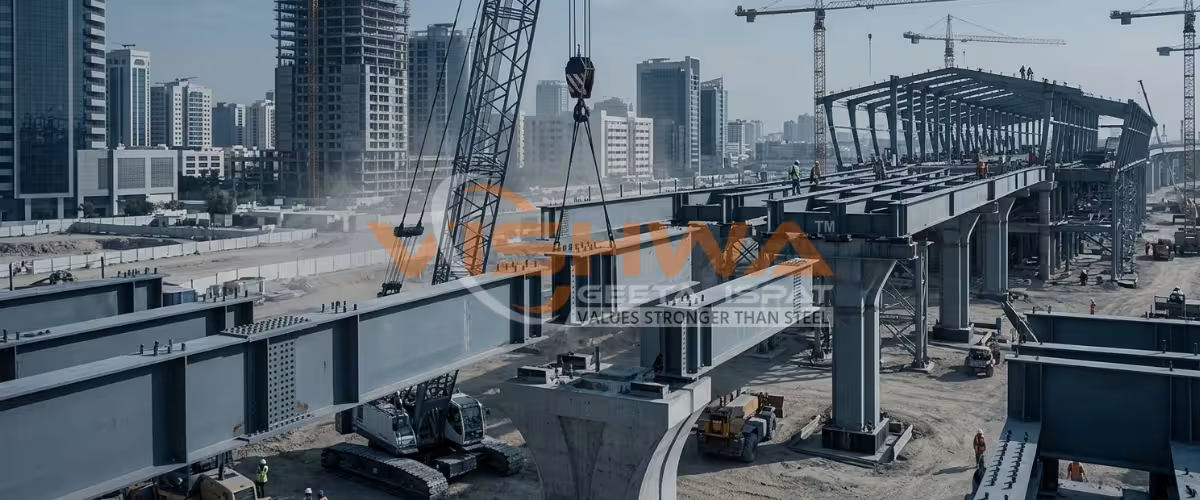
Warehouses, factories, metro stations, and logistics sheds need wide spans without too many columns. Intermediate columns restrict floor plans, reduce usable area, and complicate material movement. This is where H beams show their real structural value: they carry heavy loads across 15–30m spans and allow open layouts that support operational efficiency.
The wide flanges reduce lateral torsional buckling in long, laterally unbraced members. The deep section provides the bending stiffness needed to keep deflection within acceptable limits under full dead and live load. For industrial floors where a deflection limit of span/300 or span/500 is specified, the section depth and moment of inertia directly determine whether the limit is met — and both are read directly from the H beam size chart.

Five Key Areas Where H Beams Are the Standard Choice
Industrial Sheds · Bridges · Multi-Storey Frames · Crane Bays · Infrastructure
Industrial Sheds & Warehouses
Primary columns (ISHB 200–300) and rafters (ISHB 250–400) for portal frame sheds spanning 12–30m. The most common application for ISHB sections in Central India.
Bridges & Flyovers
Main girders, cross-girders, and bracing members in steel and composite bridges where deep sections and high flange stability are required under moving vehicular loads.
Multi-Storey Frames
Primary columns in steel-framed buildings where biaxial stiffness and connection geometry favour wide-flange sections over narrower I-beam columns.
Crane Runway Girders
Heavy ISHB sections (350–500+) as crane girder primaries in workshops and manufacturing plants with 5–50 tonne overhead cranes — a demanding fatigue environment.
Platforms & Mezzanines
Primary beams for elevated working platforms, mezzanine floors, and material handling structures where deflection control and vibration resistance are design-critical.
Temperature and Weather Impact an H Beam More Than Most People Think
Thermal Expansion · Corrosion · Coating · Maintenance
Steel expands when heated and contracts when cooled. Over a 20-metre H beam in a typical Central Indian environment, the temperature difference between a summer afternoon and a winter morning can cause 12–18mm of thermal movement. This is why expansion joints, slotted bolt holes, and flexible connections are included in steel frame designs — and why ignoring them causes connection cracking and alignment problems over time.
Corrosion is the second durability concern. Unprotected mild steel in a humid environment can lose 0.1–0.3mm of thickness per year to rust. On a beam with 6–10mm flanges, this is a meaningful proportion of section capacity over a 20-year service life. In coastal, industrial, or chemically aggressive environments, the rate is higher.
Corrosion Protection — Minimum Recommendation
- Surface preparation: blast cleaning to Sa 2.5 (IS 13944)
- First coat: zinc-rich epoxy primer (75 micron DFT minimum)
- Intermediate coat: epoxy MIO (75 micron DFT)
- Final coat: polyurethane or alkyd enamel (50 micron DFT)
- Inspection cycle: 5–7 years in normal environments; 2–3 years coastal/industrial
Applying a proper 3-coat system at installation adds approximately ₹80–120 per kg to the H beam cost. Replacing a corroded structural member in a completed building typically costs 15–30× more when downtime, temporary support, and connection repair are included.
The Future of H Beams Looks More Refined, Not Just Stronger
Higher Grades · Tighter Tolerances · Optimised Sections · Faster Fabrication
Modern structures demand more: taller buildings, wider clear spans, infrastructure that must support service ducts, solar panel mounts, green roof systems, and energy-efficient fittings. H beams are evolving to meet these demands through better alloys, tighter rolling tolerances, and improved welding compatibility rather than simply heavier sections.
In many current projects, lighter optimised sections in higher-grade steel (IS 2062 E350 or imported equivalents) are preferred over heavier E250 sections — achieving the same structural performance at 15–25% less steel weight. This reduces material cost, freight, crane requirements, and dead load on foundations simultaneously.
On the fabrication side, laser-cutting, robotic welding, and BIM-driven connection design are making H beam fabrication faster and more dimensionally accurate. This places a higher premium on steel with consistent rolling tolerances and predictable weldability — both of which are quality parameters that mill documentation confirms.
Buyers who specify only by depth and price are leaving structural performance and long-term cost on the table. Specifying grade (E250 vs E350), sub-series (ISHB 250 vs ISHB 250(1)), surface condition, and MTC requirement at the procurement stage consistently delivers better project outcomes than post-order correction.
Quick Checklist Before Ordering H Beam Steel
7 Confirmations That Prevent the Most Expensive Ordering Errors
- Application confirmed: column / primary beam / secondary beam / crane girder / rafter — each governs different dimensional priorities and ISHB size selection.
- Full section designation confirmed from drawings: including sub-series (ISHB 250 vs ISHB 250(1)). Depth alone does not identify the beam.
- Steel grade confirmed: IS 2062 E250 (standard) or E350 (higher strength). Do not compare quotes of different grades without noting the cost and performance premium.
- kg/m and total MT calculated: kg/m from IS 808 × length × pieces ÷ 1000 = MT. This is the basis for material cost and freight planning.
- MTC requested for structural work: crane bays, multi-storey frames, bridges, seismic zones, and any public-occupancy structure — always require a Mill Test Certificate.
- Corrosion protection planned: coating system, inspection cycle, and maintenance budget confirmed at design stage, not after fabrication.
- Structural engineer sign-off obtained: final section and grade selection confirmed against actual span, loading, and connection geometry by a qualified structural engineer.
Frequently Asked Questions
Common Questions on H Beam Steel, Sizes & Applications
Vishwageeta Ispat — Raipur, Chhattisgarh
Vishwageeta Ispat is Raipur's trusted iron and steel supplier — stocking MS H-Beams (ISHB series, IS 808) across all standard sizes, ISMB I-Beams, ISMC channels, MS angles, TMT bars, MS pipes, square hollow sections, and all structural steel products. We supply with IS 808-consistent dimension data, mill test certificates on request, and competitive delivered rates across Chhattisgarh and Central India.
Need the right H beam size for your project? Share section designation, quantity, and delivery location — we'll confirm kg/m from IS 808, current ₹/kg rate, and dispatch timeline same working day.