H Beam Sizes —
Small Numbers That
Decide the Structure
H beam sizes carry more importance than weight alone. Section depth, flange width, and web thickness together decide how far the beam spans, how stable it is under lateral load, how it connects to other members, and what it costs. Getting the size right is the foundation of every other structural decision that follows.
Share section size, quantity, and delivery location — we'll confirm dimensions, kg/m, and ₹/kg rate same day.
📋 Send EnquiryFill the contact form 💬 Join WhatsApp ChannelDaily rate updatesWhy H Beam Sizes End Up Deciding Half the Structure Without Anyone Noticing
Depth · Flange · Web · Cost · Safety · All Connected
H beam sizes carry more importance than weight alone. A beam can look solid and still behave poorly if the section depth is too shallow for the span, the flange is too narrow for the lateral load, or the web is too thin for the shear demand at the support. These are not rare edge cases. They are the most common source of structural under-performance in Indian construction projects — not dramatic failures, but slow deflection, visible sag, vibrating floors, and premature connection fatigue.
Contractors sometimes choose beams quickly — matching depth to a rough rule of thumb, checking the price, and moving on. The structural consequences of that shortcut typically appear after the structure is loaded and occupied: a floor that bounces, a column that shows visible lean, a weld that cracks near the connection. Every one of these problems traces back to a sizing decision that was made without reading the complete dimensions in the H beam size chart.
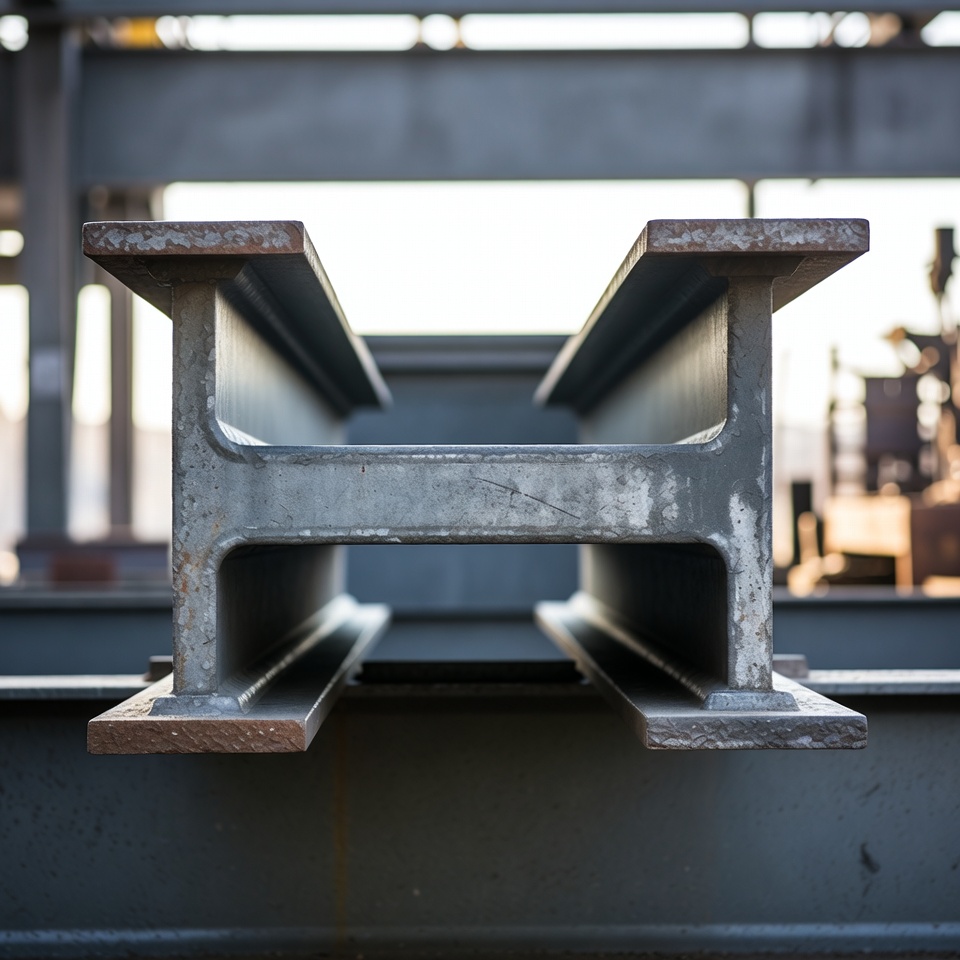
A beam can be described as "200mm H beam" and still refer to sections with kg/m values ranging from 37.3 (ISHB 200) to 45.1 (ISHB 200(1)) — a 21% difference in steel content, structural capacity, and material cost. Depth alone does not identify the beam. All five dimensions must be confirmed.
What Each Dimension in H Beam Sizes Actually Controls
Depth H · Flange Width B · Web Thickness tw · Flange Thickness tf · Weight kg/m
Every H beam size is defined by five cross-sectional dimensions. Changing any one of them changes the beam's structural behaviour — sometimes dramatically. Here is what each dimension does:
Section Depth (Height)
The vertical distance from bottom of lower flange to top of upper flange. Governs major-axis bending resistance (moment of inertia scales with depth³). The primary selection input for span capacity. Deeper sections deflect less and carry more bending moment for the same kg/m.
Flange Width
The width of the horizontal plates at top and bottom. Wide flanges provide lateral stability and resist lateral torsional buckling of the compression flange. Also governs connection geometry — bolt edge distances and end plate sizing. Critical for column applications.
Web Thickness
The thickness of the vertical connecting plate. Governs shear capacity — the vertical cutting force at support points. Also governs local web stability under concentrated loads. Thicker webs reduce the need for stiffeners at beam-to-column connections.
Flange Thickness
The thickness of the horizontal plates. Governs local flange buckling resistance and weld leg size for moment connections. Also contributes directly to the section modulus — a 2mm increase in flange thickness raises bending capacity by approximately 10–15% for a typical ISHB section.
Weight Per Metre
Derived from all four dimensions above. The direct material cost multiplier. Also governs dead load on columns and foundations, crane capacity for erection, truck capacity for freight, and fabrication labour per piece. The number procurement teams use most — but it is a consequence of geometry, not a selector.
Why a Few Millimetres in H Beam Sizes Change Everything
Non-Linear Effects · Bending Capacity · Shear · Stability
The Non-Linear Effect of Depth
Bending stiffness (moment of inertia about the major axis) scales with the cube of depth. Going from an ISHB 200 (200mm deep) to an ISHB 250 (250mm deep) — an increase of just 50mm — raises the major-axis moment of inertia by approximately 2.4×. The beam is 2.4 times stiffer in bending for a 25% increase in depth.
This is why structural engineers are very specific about section depth — it is not a dimension that can be substituted up or down without recalculating the entire beam design. A 10% depth reduction can require a 30% increase in web area to compensate. There is no easy direct substitution.
The Linear but Significant Effect of Flange Thickness
Flange thickness contributes to the section modulus approximately in proportion to its value. For ISHB 250, the two variants are:
- ISHB 250: tf = 9.7mm, kg/m = 51.0
- ISHB 250(1): tf = 11.1mm, kg/m = 61.3
The 1.4mm difference in flange thickness adds approximately 20% to the section's bending resistance. At the same span and load, the (1) variant provides substantially more structural margin — which is why the design drawing will specify exactly which variant is required. Substituting one for the other is not a minor procurement decision.
Web thickness changes similarly propagate into shear capacity. A 2mm increase in web thickness for an ISHB 300 adds approximately 15–18% to the shear resistance at the support — a meaningful difference when the beam is close to its shear capacity limit.
H Beam Sizes Reference Table — ISHB Series (IS 808)
Key Sizes · Depth · Flange Width · Web · Flange · kg/m
The most commonly stocked ISHB sections in Central India. Use this as a quick reference — always confirm with the full IS 808 table for structural design work. The (1) sub-series has the same depth as the base section but heavier web and flange dimensions.
| Section | Depth H (mm) | Flange B (mm) | Web tw (mm) | Flange tf (mm) | Weight kg/m | Typical Use |
|---|---|---|---|---|---|---|
| ISHB 150 | 150 | 100 | 5.4 | 7.8 | 24.0 | Light mezzanine secondary members, light frames |
| ISHB 200 | 200 | 200 | 6.1 | 9.0 | 37.3 | Light columns, mezzanine primary beams, small sheds |
| ISHB 200 (1) | 200 | 200 | 7.8 | 10.3 | 45.1 | Medium columns, higher-load mezzanines |
| ISHB 225 | 225 | 225 | 6.5 | 9.1 | 43.1 | Warehouse columns, primary beams 8–12m span |
| ISHB 250 | 250 | 250 | 6.9 | 9.7 | 51.0 | Industrial shed columns, primary beams 10–15m |
| ISHB 250 (1) | 250 | 250 | 8.8 | 11.1 | 61.3 | Heavy columns, crane bay supports |
| ISHB 300 | 300 | 250 | 7.6 | 10.6 | 58.8 | Multi-storey frame columns, wide-span primary beams |
| ISHB 300 (1) | 300 | 250 | 9.4 | 11.6 | 70.1 | Heavy industrial columns, crane girders |
| ISHB 350 | 350 | 250 | 8.1 | 11.6 | 67.4 | Large span portal rafters, heavy primary beams |
| ISHB 400 | 400 | 250 | 8.8 | 12.7 | 77.4 | Crane runway girders, long-span frames 15–20m |
| ISHB 450 | 450 | 250 | 9.8 | 13.7 | 87.2 | Heavy crane girders, bridge elements |
| ISHB 500 | 500 | 250 | 10.2 | 14.7 | 95.0 | Heavy industrial primary members, transfer beams |
| Selected common sizes from IS 808 ISHB series. All values nominal — ±2.5% rolling tolerance per IS 1852. Full IS 808 table includes additional sizes and sub-series. Grade: IS 2062 E250 standard. Request MTC for structural applications. | ||||||
Cost Impact of Wrong H Beam Sizes — and How Engineers Verify Selection
Oversize · Undersize · Sub-Series Error · Verification Sequence
The Real Cost of Getting Size Wrong
The cost of a size error is not just the price difference between two sections. It includes the full chain of consequences: additional freight for a heavier beam, larger crane category for erection, potential foundation over-load requiring redesign, and if under-specified, the eventual cost of structural reinforcement or replacement.
A procurement team that selects ISHB 250(1) (61.3 kg/m) when the design requires ISHB 250 (51.0 kg/m) adds 10.3 kg/m of unnecessary steel. On a 50-piece order at 9m: that is 10.3 × 9 × 50 = 4,635 kg = 4.64 MT extra. At ₹61/kg: ₹2,82,735 wasted before GST and freight. A chart check of under 5 minutes prevents this entirely.
The opposite error — specifying ISHB 250 when the design requires ISHB 250(1) — saves ₹2.83 lakh at procurement and then spends ₹15–30 lakh on structural remediation after deflection is observed under service load.
How Engineers Verify Size Selection
After completing structural calculations (span, load, bending moment diagram, shear envelope), engineers select sections from the IS 808 table by matching the required section modulus (Zxx) and moment of inertia (Ixx) against available ISHB sizes. This confirms both strength (Zxx ≥ design requirement) and stiffness (Ixx governs deflection).
The second check is the lateral torsional buckling (LTB) check — which depends on flange width relative to depth. Narrow-flange sections (ISHB 300 through ISHB 600 have B=250mm vs H=300–600mm) have less LTB resistance than sections where B≈H (ISHB 200 through ISHB 250). This is why the structural drawing specifies the exact section designation — not just a depth.
The procurement team's role is to ensure the section ordered from the supplier matches the designation on the drawing exactly — section code, sub-series, grade, and length. The size chart is the tool that makes this verification possible.
Safety and Correct H Beam Sizing — Why Dimensions Are a Safety Issue
Structural Adequacy · Dead Load · Vibration · Long-Term Service
| Scenario | Structural Consequence | Safety Risk |
|---|---|---|
| Correct size per design | Deflection, capacity, connections all within design limits | No elevated risk — design margins maintained |
| Undersize (too shallow or too light) | Excessive deflection; potential connection fatigue; beam approaches capacity under design load | Elevated — visible sag, vibration, fatigue cracking at high load |
| Wrong sub-series (lighter than specified) | Lower section modulus than design assumed; beam may reach yield at service load | Significant — may not be visible until load is increased or combined with wind/seismic |
| Oversize (heavier than designed) | Dead load increase on columns, connections, foundations beyond design capacity | Moderate — typically requires foundation review; not immediately visible |
| Wrong section series (ISMB instead of ISHB) | Different flange width and geometry; section properties do not match design | High for column applications — ISMB has much lower minor-axis stiffness |
The critical safety point is that most H beam size errors are not immediately visible. The structure stands. Daily loads are carried. The problem emerges gradually — a floor deflects 2–3mm more than expected, a column shows micro-cracks at the base, wind loading causes visible sway. By the time these symptoms appear, repair costs are 5–20× the original procurement saving.
Common H Beam Sizes by Application — and the Pre-Order Checklist
Sheds · Warehouses · Multi-Storey · Crane Bays · Mezzanines
Quick Application Guide
Small industrial sheds (12–18m span): ISHB 200 to ISHB 250 for columns; ISHB 250 to ISHB 300 for rafters depending on purlin spacing and wind load.
Medium warehouses (18–30m span): ISHB 250(1) to ISHB 300 for columns; ISHB 300 to ISHB 400 for primary frames. Engineer verification essential for this span range.
Multi-storey frames: ISHB 250 to ISHB 350 for columns depending on storey height and load; ISMB I-beams often used for secondary floor beams with H-beams for primary members.
Crane bays (5–20 tonne cranes): ISHB 300(1) to ISHB 450 for crane runway girders; ISHB 350 to ISHB 500 for columns depending on crane capacity and bay spacing. Structural engineer specification mandatory.
Mezzanine primary beams: ISHB 200 to ISHB 300 depending on span and loading; ISHB 200 and 225 are the most commonly used range for standard 6–10m mezzanine spans.
When to Upgrade from the Minimum Size
The structural design gives a minimum section. Consider one size up from the minimum if:
- The structure will carry dynamic or moving loads (cranes, forklifts, vibrating machinery)
- The floor has strict deflection requirements (precision machinery, sensitive equipment)
- The structure is in a high-wind or seismic zone where fatigue loading is a concern
- Future load additions are anticipated (second storey, additional equipment)
- The unbraced length of the compression flange is at the design limit
In every case, confirm with the structural engineer before moving to a larger size — oversizing has its own cost and structural consequences as shown in the safety table above.
Pre-Order Checklist
- Application confirmed: column / beam / crane girder / rafter — each governs different dimensional priorities from the size chart.
- Full section designation confirmed from drawings: ISHB 250 and ISHB 250(1) are different sections. The designation on the structural drawing — including sub-series — must match the section ordered.
- All five dimensions confirmed: depth H, flange width B, web thickness tw, flange thickness tf, and kg/m from IS 808 — not just depth alone.
- Grade confirmed: IS 2062 E250 (standard) or E350 (higher strength). Do not compare quotes of different grades without noting the cost premium.
- Length and quantity confirmed: standard 6m or 12m, or fixed cut-to-length. Fixed lengths incur a surcharge. Quantity in pieces and total MT for freight planning.
- Structural engineer sign-off obtained: for crane bays, multi-storey frames, wind/seismic zones, and any application involving public occupancy.
Frequently Asked Questions
Common Questions on H Beam Sizes, Dimensions & Selection
Vishwageeta Ispat — Raipur, Chhattisgarh
Vishwageeta Ispat is Raipur's trusted iron and steel supplier — stocking MS H-Beams (ISHB series, IS 808) across standard sizes, ISMB I-Beams, ISMC channels, MS angles, TMT bars, MS pipes, square hollow sections, and all structural steel products. We provide confirmed IS 808 dimensions, mill test certificates on request, and competitive delivered rates across Chhattisgarh and Central India.
Need the right H beam size for your project? Share section designation, quantity, and delivery location — we'll confirm kg/m from IS 808, current ₹/kg rate, and dispatch timeline same working day.