MS Flat Weight Chart (kg/m) + Live Calculator
In steel buying, the shape is simple — the weight decides the bill. Whether you call it MS Flat, Iron Patti, or Loha Patti, this chart and calculator help you estimate costs, plan transport load, and avoid invoice surprises at site.
Share size (W×T), length, and quantity — we respond with a clean quote and weight estimate.
Request Quote24-Hour Response Join WhatsApp ChannelDaily Rate Updates Call: 9200049000Direct Sales Line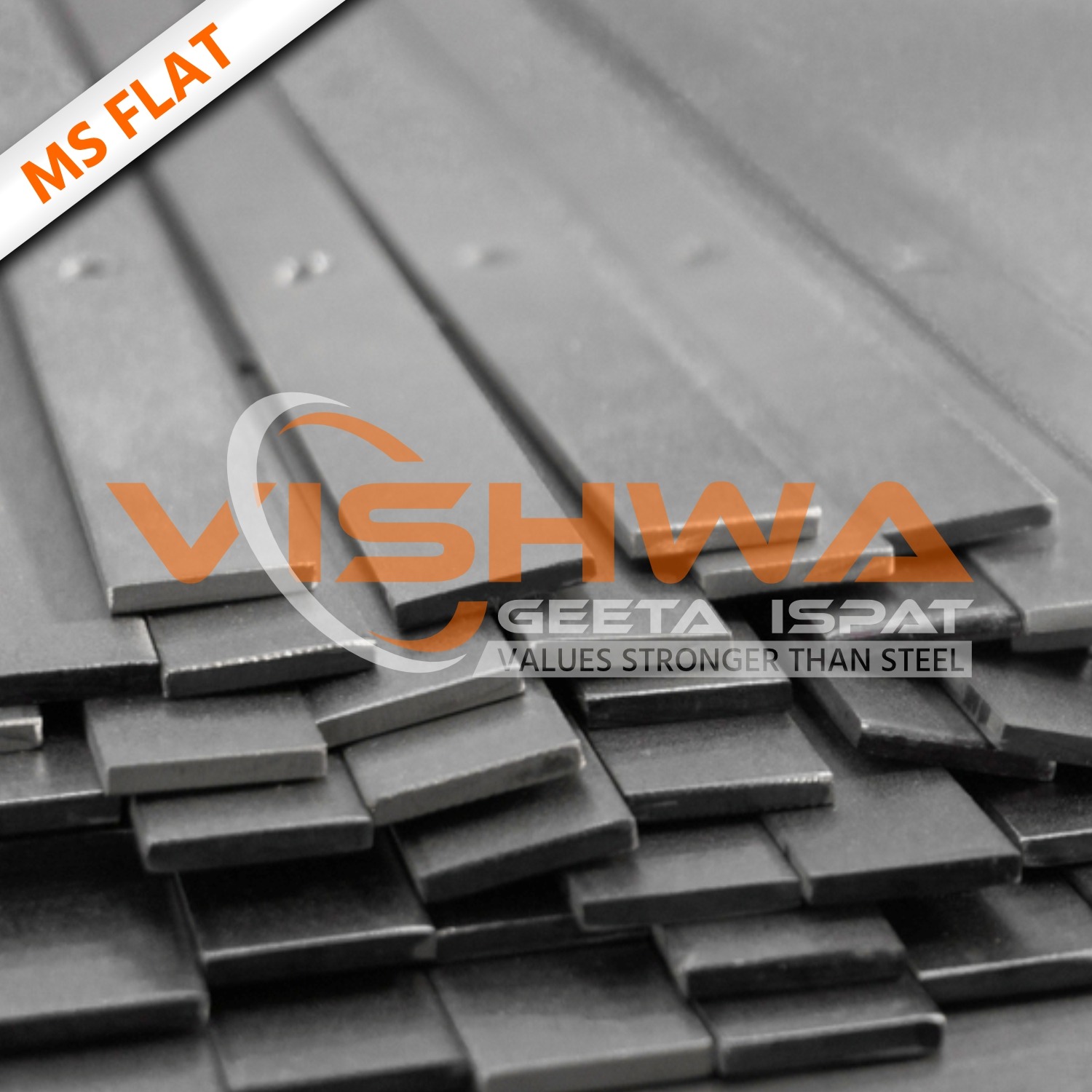
Fig 1 — MS Flat bars (Iron Patti / Loha Patti) — used across frames, base plates, brackets, racks, and general fabrication.
MS Flat, Iron Patti, Loha Patti — different names, same product: a rectangular mild steel flat bar with straight edges and uniform thickness. Sizes vary widely (20×3 mm to 100×20 mm and beyond), so a size-wise weight chart is the fastest way to plan budget, quantity, and handling. This page gives you the formula, a live calculator, and a ready chart for 30 common market sizes.
- What is MS Flat (Iron Patti / Loha Patti)? — Product, uses, why weight matters
- Weight formula — simple and reliable — Width × Thickness × 0.00785
- Live Calculator — instant kg/m and total
- Weight chart — 30 common market sizes
- Where MS Flats are used
- Common buyer mistakes with weight
- FAQ — MS Flat weight questions
What is MS Flat (Iron Patti / Loha Patti)?
Rectangular Flat Bar • Uniform Cross-Section • Fabrication Staple
An MS Flat bar is a mild steel product with a simple, consistent rectangular cross-section — defined by its width (W) and thickness (T) in millimeters. The straight edges, uniform thickness, and easy machinability make it the most versatile flat steel product for fabrication.
Always order by size (Width × Thickness) and length — not by description or visual. Billing follows total kg, so weight per meter drives every cost calculation. Fabricators use charts to estimate frames, gates, racks, and supports. Transport planning becomes accurate only when total kg is known in advance.
Weight Formula — Simple and Reliable
Standard Derivation • Steel Density • How to Apply It
The MS Flat weight formula uses only two inputs — width and thickness in millimeters — and a single density constant. It is the same formula used by suppliers, fabricators, and engineers across India daily.
Total Weight (kg) = kg/m × Length (m)
Live Calculator — Instant kg/m and Total Weight
Select Width & Thickness • Enter Length • Instant Result
If an MS Flat is lighter than your requirement allows, stiffness in fabricated parts may be insufficient. If it's heavier, it increases billing and transport cost unnecessarily. Getting the right size is more important than staying with a "standard" selection. Use the calculator to compare sizes before ordering.
MS Flat Weight Chart — Common Market Sizes
30 Common Sizes • kg/m, 6m and 12m Weights • Application Notes
All values are calculated using the standard formula (W × T × 0.00785). Use as an estimation and planning tool for cost, transport load, and fabrication quantity. For billing-critical applications, verify on receipt against MTC.
| Size (mm) | Width | Thickness | Weight (kg/m) | Weight (kg/6m) | Weight (kg/12m) | Application Notes |
|---|---|---|---|---|---|---|
| 20 × 3 | 20 | 3 | 0.471 | 2.826 | 5.652 | Light fabrication, small brackets |
| 20 × 5 | 20 | 5 | 0.785 | 4.710 | 9.420 | General workshop use |
| 25 × 3 | 25 | 3 | 0.589 | 3.532 | 7.065 | Frames, light supports |
| 25 × 5 | 25 | 5 | 0.981 | 5.887 | 11.775 | Common for grills, racks |
| 25 × 6 | 25 | 6 | 1.177 | 7.065 | 14.130 | Heavier bracket work |
| 32 × 5 | 32 | 5 | 1.256 | 7.536 | 15.072 | Fabrication members |
| 32 × 6 | 32 | 6 | 1.507 | 9.043 | 18.086 | Supports, stiffeners |
| 40 × 5 | 40 | 5 | 1.570 | 9.420 | 18.840 | Frames, base parts |
| 40 × 6 | 40 | 6 | 1.884 | 11.304 | 22.608 | General structural fabrication |
| 40 × 8 | 40 | 8 | 2.512 | 15.072 | 30.144 | Heavier frames & plates |
| 50 × 5 | 50 | 5 | 1.962 | 11.775 | 23.550 | Common industrial use |
| 50 × 6 | 50 | 6 | 2.355 | 14.130 | 28.260 | Supports, gussets |
| 50 × 8 | 50 | 8 | 3.140 | 18.840 | 37.680 | Base plates, heavy racks |
| 50 × 10 | 50 | 10 | 3.925 | 23.550 | 47.100 | High load fabrication parts |
| 60 × 6 | 60 | 6 | 2.826 | 16.956 | 33.912 | Frames & stiffeners |
| 60 × 8 | 60 | 8 | 3.768 | 22.608 | 45.216 | Heavier supports |
| 65 × 6 | 65 | 6 | 3.061 | 18.369 | 36.738 | Industrial brackets |
| 65 × 8 | 65 | 8 | 4.082 | 24.492 | 48.984 | Heavier fabrication |
| 75 × 6 | 75 | 6 | 3.532 | 21.195 | 42.390 | Common site supports |
| 75 × 8 | 75 | 8 | 4.710 | 28.260 | 56.520 | Load-carrying members |
| 75 × 10 | 75 | 10 | 5.887 | 35.325 | 70.650 | Heavy gates / frames |
| 80 × 8 | 80 | 8 | 5.024 | 30.144 | 60.288 | Industrial fabrication |
| 80 × 10 | 80 | 10 | 6.280 | 37.680 | 75.360 | Heavier supports |
| 90 × 10 | 90 | 10 | 7.065 | 42.390 | 84.780 | High load applications |
| 100 × 6 | 100 | 6 | 4.710 | 28.260 | 56.520 | Frames & plates |
| 100 × 8 | 100 | 8 | 6.280 | 37.680 | 75.360 | Heavy frames |
| 100 × 10 | 100 | 10 | 7.850 | 47.100 | 94.200 | Base plates / supports |
| 100 × 12 | 100 | 12 | 9.420 | 56.520 | 113.040 | Very heavy fabrication |
| 100 × 16 | 100 | 16 | 12.560 | 75.360 | 150.720 | High load structural parts |
| 100 × 20 | 100 | 20 | 15.700 | 94.200 | 188.400 | Industrial heavy duty |
Find your size (width × thickness) → read kg/m → multiply by total meters needed → compare with 6m or 12m weight columns for standard lengths. This gives an accurate estimate before dispatch and eliminates misunderstandings at billing time.
Where MS Flats Are Used — and Why Weight Matters for Each
Fabrication • Construction • Industrial • Consistent Geometry
MS Flats are used wherever straight edges, consistent thickness, and easy machinability are needed. You'll find them in frames, base plates, supports, brackets, racks, grills, and general industrial parts across construction and manufacturing.
- Gate and grill fabrication: 25×5, 40×6, 50×6 are the most common — flat bars provide the outer frame and internal bar structure
- Industrial racks and shelving: heavier sizes (50×8, 75×8) for load-bearing horizontal members
- Machine bases and frames: 50×10, 75×10, 100×10 for structural rigidity under vibration and dynamic load
- Base plates and anchor plates: 100×12 and 100×16 for heavy equipment mounting where load distribution is critical
Weight matters beyond billing. A flat that is too light for its application will flex, vibrate, or deform under load — compromising the fabricated structure's performance. A flat that is too heavy adds unnecessary dead load and material cost.
Two apparently similar flats — 50×6 and 50×8 mm — look nearly identical on site. But 50×8 weighs 3.14 kg/m vs 2.355 kg/m for 50×6 — a 33% difference. Over 100 meters, that's 78.5 kg additional weight and proportionally more cost. The chart makes this visible before the purchase order is placed.
Common Mistakes Buyers Make With MS Flat Weight
Five Errors — And the Correct Practice for Each
❌ Common Mistakes to Avoid
- Comparing only width, ignoring thickness — 50×5 and 50×10 look similar in description but have 2× different weight and cost; thickness difference is the bigger cost driver
- Mixing kg/m with total kg — treating the per-meter weight as if it were the complete piece weight; a 75×8 flat at 4.71 kg/m in 12m lengths weighs 56.52 kg per piece, not 4.71 kg
- Budgeting by piece count — estimating cost from number of pieces without converting to total kg first; steel price is per kg, not per piece
- Not accounting for cutting wastage — fabrication always creates scrap; for nested cutting jobs, add 5–10% to quantity estimate
- Using old or unverified charts — charts from different sources may use different density constants or tolerances; always use confirmed chart with correct formula (0.00785)
✅ Simple Safe Practice
- Specify both width AND thickness — always include full dimension notation: "50×6 mm MS Flat" not just "50 mm flat"
- Calculate total weight correctly — kg/m × length in meters × number of pieces = total project weight in kg
- Compare cost per kg, not per piece — confirm rate per kg with supplier, then multiply by total calculated weight for accurate cost estimate
- Add 5–8% to calculated quantity — for fabrication cutting and wastage, especially for smaller pieces cut from standard length bars
- Request kg/m confirmation from supplier — ask supplier to confirm kg/m for the specific size being supplied; this allows bilateral verification before dispatch
FAQ — MS Flat Weight Chart Questions Answered
Common Questions • Formula • Billing • Size Selection
Vishwageeta Ispat — Raipur, Chhattisgarh
Vishwageeta Ispat supplies MS Flat bars (Iron Patti/Loha Patti), MS angles, MS pipes, structural sections, and all construction steel products for fabrication, construction, and industrial projects across Chhattisgarh and Central India. We stock all standard market sizes in IS 2062 grade. Share your size (Width × Thickness), required length, and quantity — we confirm kg/m, calculate total weight, and respond with a competitive quote within 24 hours.
No billing surprises. Confirmed specifications, transparent pricing, and fast dispatch from Raipur.