Deck Sheet Thickness
How to Choose the
Right Option
Thickness is the single most consequential spec decision for any deck sheet purchase. It determines strength, sag resistance, dent resistance, wind uplift safety, and long-term durability. This guide explains how to choose correctly — for roofing, cladding, and structural composite floor decking.
Not sure which thickness is right for your project? Share your span, application, and location — we'll recommend the correct BMT and specification.
📋 Send EnquiryFill the contact form 💬 Join WhatsApp ChannelRate updates dailyWhy Deck Sheet Thickness Is the Most Important Specification
Structural Performance · Durability · Sag · Dent Resistance · Wind Uplift
A deck sheet may look like a simple product — but once installed, it is a structural element taking real-world stress every single day: wind uplift cycles during storms, thermal expansion through temperature swings, point loads from maintenance foot traffic, wet debris accumulation on low-slope roofs, and vibration fatigue on industrial roofs near machinery. Thickness determines how the sheet handles every one of these demands.
Two sheets that look identical — both galvanized, same profile, same colour — can perform completely differently if one is 0.45mm BMT and the other is 0.35mm BMT. The thinner sheet is 22% lighter per m², which looks like a cost saving. But it is also significantly more prone to denting, sag, and fastener fatigue. The "saving" reverses within the first monsoon season when laps start leaking and panels need replacement.
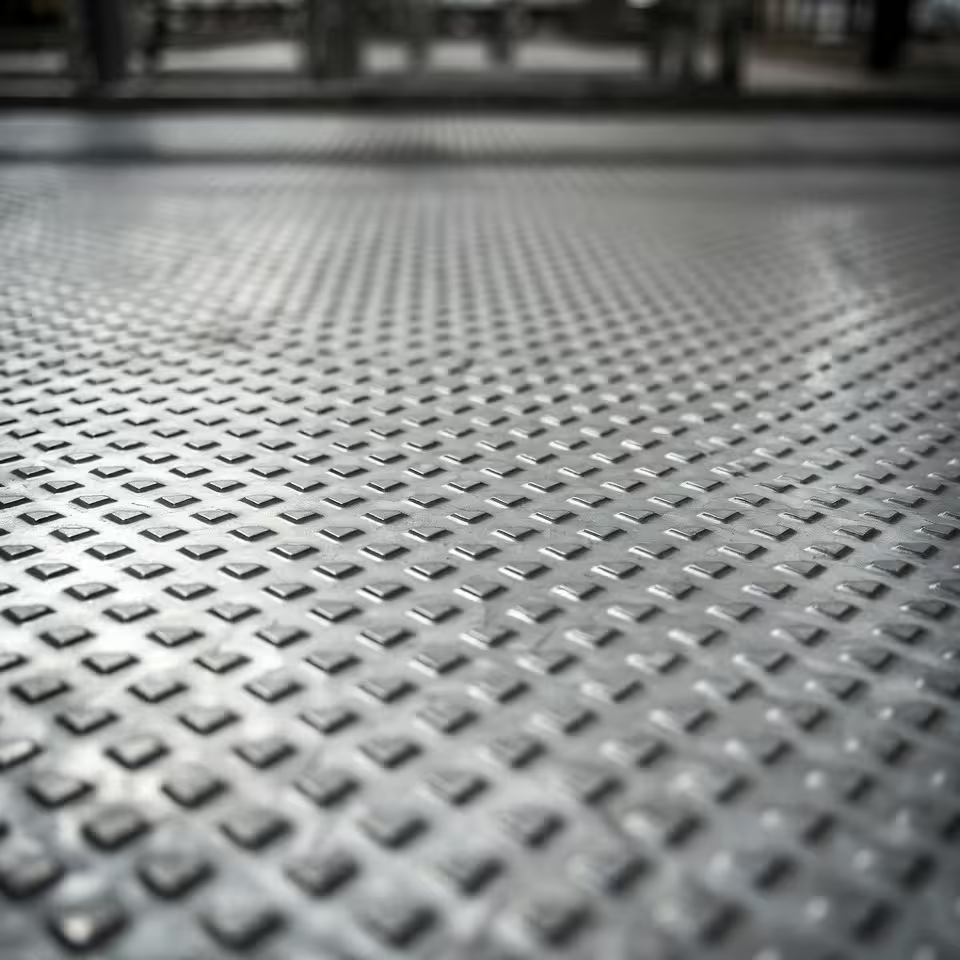
BMT (Base Metal Thickness) is the steel thickness before any coating is applied. This is the number that governs strength, span capacity, deflection, dent resistance, and fastener performance. TCT (Total Coated Thickness) is larger because it includes the zinc and/or paint — but those coatings carry no structural load. Always specify, compare, and verify BMT in mm when buying deck sheets.
BMT vs TCT — The Two Thickness Terms You Must Know
Base Metal Thickness · Total Coated Thickness · Why the Difference Matters
Most deck sheet confusion in procurement comes from mixing up these two terms. A supplier may quote "0.50mm" without specifying whether they mean BMT or TCT — and the difference can be 0.05–0.12mm of actual steel. Here is the definitive explanation.
Base Metal Thickness
The actual thickness of the steel substrate — measured before any zinc coating, primer, or top coat is applied. This is the engineering-critical number.
- Governs bending stiffness and span capacity
- Controls dent resistance during handling and service
- Determines fastener pull-out strength at the sheet
- Sets the deflection limit under distributed load
- Used in all structural span and load calculations
Total Coated Thickness
BMT plus all coating layers — zinc galvanizing, primer, and top coat paint. TCT is always larger than BMT. The difference depends on the coating specification.
- Governs corrosion resistance and coating life
- Determines finish quality and colour retention
- Affected by zinc coating weight (GSM) and paint system
- A heavier coating adds 0.04–0.12mm to TCT vs BMT
- Does not contribute to structural load capacity
Always specify: "Thickness: [X.XX] mm BMT" — not just "thickness [X.XX]mm" or "gauge [XX]G". This single word prevents the most common substitution error in deck sheet procurement, where a supplier delivers a sheet with slightly lower BMT that meets the TCT number you specified but carries less steel.
Gauge vs Millimeter — The Classic Trap That Costs Buyers Money
Lower Gauge = Thicker · Multiple Standards · Always Verify in mm BMT
Many buyers in India request deck sheets by gauge number — "26 gauge" or "28 gauge" — because that is how they have always specified it. The problem is that different gauge standards exist (SWG, BWG, USG, ISG) and they do not all agree on what thickness a given gauge number represents. A "26 gauge" sheet from one supplier may differ by 0.05–0.08mm in actual BMT from another — a meaningful difference at thin gauges.
Approximate Gauge to mm Mapping (Indicative)
Lower gauge = thicker sheet. These are approximate — always confirm exact BMT with your supplier:
30G ≈ 0.28–0.32mm
28G ≈ 0.35–0.40mm
26G ≈ 0.45–0.50mm
24G ≈ 0.55–0.63mm
22G ≈ 0.70–0.80mm
20G ≈ 0.90–1.00mm
These values vary by gauge standard. Never use gauge as the sole specification — always require BMT in mm on the invoice.
Copy-Paste: What to Ask Your Supplier
To avoid gauge confusion, send this exact specification request:
"Please confirm deck sheet thickness as BMT in mm (not TCT). Also confirm: coating type (GI / PPGI), coating specification (zinc GSM or paint system), profile type, effective cover width, and recommended purlin spacing for my span."
A supplier who cannot answer these questions clearly is not the right supplier for a project that depends on structural performance.
Deck Sheet Thickness Chart — Quick Selection by Application
Residential Roofing · Industrial Roofing · Wall Cladding · Composite Floor Decking
Use this chart as a fast first-reference. Final thickness must always be validated against your specific profile, support spacing, wind zone, and design loads — particularly for composite floor decking where the structural engineer's drawing governs. The composite floor rows are highlighted.
| Application | Typical BMT Range | Key Reason for This Range | India Practical Note |
|---|---|---|---|
| Residential roofing · small sheds | 0.35 – 0.45mm | Light loads, tight purlin spacing, low foot traffic. Adequate for most residential shelters with 1.2–1.5m purlin spacing. | Move to upper end (0.45mm) in monsoon-heavy districts or for sloped roofs over 15° where wind uplift is higher. |
| Industrial roofing · warehouses · factories | 0.45 – 0.60mm | Better dent resistance, improved fastener sealing, reduced oil-canning, suitable for wider purlin spacing up to 1.8m. | Standard for most industrial and commercial roof projects in Central India. Most stocked size range at Raipur suppliers. |
| Wall cladding · side sheets | 0.35 – 0.50mm | Lower live load than roofs. Wind pressure on walls can still be significant — choose based on building height and wind exposure category. | For buildings over 12m height or near open/coastal areas, 0.50mm provides better stiffness against wind racking and vibration. |
| High-wind zone · coastal · aggressive environment | 0.50 – 0.60mm+ | Thickness + coating working together resists fluttering, fastener fatigue, and coating failure from deformation under repeated wind cycles. | Supplement with a higher zinc GSM coating (180–275 GSM) or PVDF coating for coastal proximity or chemical atmosphere. |
| Composite floor decking — standard spans | 0.80 – 1.00mm | Must carry wet concrete (2,400 kg/m³) + construction live load during pour, then function as permanent tension reinforcement in the cured slab. | 51mm rib profile at 0.80–1.00mm BMT covers most residential and commercial composite slabs with spans up to 3m. Engineer to confirm. |
| Composite floor decking — medium spans | 1.00 – 1.20mm | Wider bay spacing (3–3.5m), higher slab design loads, or stricter deflection criteria require additional thickness to control mid-span deflection during pour. | Industrial warehouse mezzanines, commercial office floors, and parking structures typically fall in this range. Always follow structural drawings. |
| Heavy-duty floor deck — long spans / high loads | 1.20 – 1.50mm | Large-span industrial floors, heavy racking loads, or high construction loads. Section properties of thicker sheet significantly reduce deflection and propping requirements. | Engineer-specified only — always confirm with structural drawings. Heavier sheets reduce the number of temporary props needed during pour. |
| All values are indicative BMT ranges. Highlighted rows (composite floor decking) must always be confirmed by a structural engineer — do not self-specify deck thickness for structural slabs. Final selection depends on profile, span, load, and site conditions. | |||
In Central India and other monsoon-intensive regions, moving one step thicker than the minimum — especially where purlin spacing is at the upper limit — significantly improves lap sealing stability during sustained wind-driven rain. Laps on thin sheets that have experienced repeated thermal cycling are the most common source of roof leaks from year 3 onwards. The extra ₹3–5/kg for the thicker option pays for itself in avoided repair costs.
How to Choose the Right Deck Sheet Thickness — 4 Factors
Span & Support · Loads · Wind Zone · Environment & Lifecycle
Selecting deck sheet thickness is not a single-variable decision. It requires matching the sheet to how your structure will actually behave over its service life. These four factors must all be considered together:
Factor 1: Span & Support Spacing
The wider the distance between purlins or support beams, the more the sheet must span unsupported. A sheet that performs well at 1.2m purlin spacing may show visible sag or oil-canning at 1.8m with the same thickness.
- Tight spacing (0.9–1.2m) → thinner BMT may be adequate
- Standard spacing (1.2–1.5m) → minimum recommended BMT for zone
- Wide spacing (1.5–1.8m+) → move one step thicker than the minimum
- Floor decking span → structural engineer's determination only
Factor 2: Loads
Loads on a deck sheet are not just structural — they include operational loads that accumulate over time and may not be in the original spec.
- Foot traffic: maintenance workers on roof = point loading
- Wet debris: pooled water + leaf/dust accumulation = distributed load
- Equipment movement: rooftop HVAC, solar panels, pipe supports
- Construction loads: workers and materials during installation phase
- If any of these apply, bias toward the thicker end of the range
Factor 3: Wind Zone
India has four wind zones (IS 875 Part 3). Wind uplift — the suction force that tries to peel the roof off the structure — is often the governing load for thin roof deck sheets.
- Higher wind zone → stronger uplift → more fasteners AND thicker sheet
- Eave and ridge areas experience highest uplift — critical specification zones
- Low-slope roofs are more vulnerable to wind-driven rain infiltration at laps
- Coastal zones: combine thicker BMT with heavier zinc coating for corrosion protection
Factor 4: Environment & Lifecycle
The environment determines how quickly coatings degrade — and a degraded coating exposes the base metal, making BMT even more critical for corrosion resistance.
- Industrial atmosphere: fumes and chemicals accelerate zinc consumption — use 275 GSM zinc or PVDF
- Coastal proximity: salt air attacks zinc — specify thicker BMT as backup
- High temperature cycling: thin sheets oil-can and warp more under expansion
- Expected service life: budget roofing (10 years) vs permanent structure (25+ years) — different thickness decisions
Light-duty + tight support spacing + sheltered location: lower end of the range is acceptable, specified as BMT.
Industrial use + wider spans + high wind exposure: upper end or one step above the range minimum.
Composite floor decking: thickness is a structural engineering decision — never self-specify.
Thickness as a Lifecycle Investment — Why Thicker Often Wins on Total Cost
Maintenance Cost · Replacement Cycles · Coating Integrity · Standardisation
The procurement cost of a deck sheet is a one-time decision. The maintenance cost is a recurring expense for the life of the building. Projects that optimise on initial material cost without considering lifecycle cost consistently end up paying more in repairs, downtime, and early replacement. Here is the full picture:
What Thicker BMT Improves Over Time
Fewer dents from installation: contractors dropping tools, workers stepping on insufficiently supported panels, and equipment movement during construction all create dent marks. On a 0.35mm sheet, these dents are permanent. On a 0.50mm sheet, minor impacts are resisted. On 0.80mm+, the sheet handles typical site activity without visible damage.
More stable fastener zones: over 10–20 years, wind cycling causes micro-movement at fastener points. Thicker sheets distribute this movement better, maintaining the clamping force and sealing integrity of the fastener. Thin sheets elongate the fastener hole over time, creating leaks even without any visible damage to the sheet surface.
Better coating adhesion: coating systems (zinc or paint) are more stable on thicker base metal because the metal deforms less under thermal and mechanical stress. Fewer micro-cracks in the coating means slower corrosion initiation and longer overall service life.
Standardising Your Specification
For any project that uses multiple deck sheets — and most projects do — standardise on a single BMT across the whole roof or floor system. Mixing different thicknesses creates visual inconsistency, complicates replacement stock management, and can introduce stress concentrations at junctions between panels of different stiffness.
When placing a purchase order, always specify:
• Thickness: [X.XX] mm BMT
• Coating: GI / PPGI + coating class (e.g. Z275 for 275 GSM zinc)
• Profile: profile type name + rib depth + effective cover width
• Sheet length: cut-to-length in metres
• Fastener pattern: confirm recommended fastener type and spacing for your purlin spacing and wind zone
A supplier who confirms all five elements is one you can trust for consistent repeat supply throughout the project.
Frequently Asked Questions
Common Queries on Deck Sheet Thickness, BMT vs TCT, and Specification
Vishwageeta Ispat — Raipur, Chhattisgarh
Vishwageeta Ispat is Raipur's trusted iron and steel supplier — stocking galvanized and pre-painted deck sheets across all standard thickness ranges (0.35mm to 1.5mm BMT), TMT bars (IS 1786), MS angles (IS 808), MS pipes (IS 1239), square hollow sections (IS 4923), H-Beams, ISMC channels, and all structural steel products. This guide is published as a free technical reference for builders, contractors, structural engineers, and procurement teams across Chhattisgarh and Central India.
Not sure which deck sheet thickness is right for your project? Share your application, span, wind zone, and location — we'll recommend the correct BMT, profile, and coating specification, and provide a transparent quote with delivery terms.