Deck Sheet —
Why It Is More
Than "Just Metal"
A deck sheet supports roofs, floors, and whole structures. Choosing the wrong one causes sagging, leaks, and safety problems. This guide explains every decision — types, thickness, coatings, applications, installation, and maintenance — so you buy once and buy right.
Share your application, span, and environment — we'll recommend the correct profile, thickness, and coating and send a same-day quote.
📋 Send EnquiryFill the contact form 💬 Join WhatsApp ChannelDaily rate updatesWhat Is a Deck Sheet — and Why Does It Matter
Profiled Metal Sheet · Engineered for Load · More Than a Cover
A deck sheet is a profiled metal sheet — usually galvanized or pre-painted steel — used as structural support for roofs, floors, and mezzanine platforms. Unlike a flat metal sheet, a deck sheet is roll-formed into a corrugated or trapezoidal profile. That profile is not decorative. It is engineered geometry that dramatically increases the sheet's bending stiffness and load-carrying capacity relative to its weight.
Anyone who has worked in construction or roofing knows that a deck sheet is not "just a piece of steel." It carries wind uplift on every storm, distributes floor loads to supporting beams, and resists the daily temperature cycling of a steel roof in the Chhattisgarh summer. Thickness, material, coating, and profile work together. Changing any one of them changes the performance. Choosing the wrong combination causes sagging, leaks, premature corrosion, and in structural floor applications, potential safety failure.
If you "save" on deck sheet quality — thinner gauge, lower coating specification, or wrong profile for the span — you typically pay 3–5× more in repairs, re-roofing, or structural remediation within 5–8 years. A deck sheet is a lifecycle investment, not a consumable.
Different Types of Deck Sheets — and What Each One Is For
Corrugated · Trapezoidal · Pre-Painted · Galvalume · Composite Floor Deck
Not all deck sheets are the same product. The profile shape determines how the sheet spans between supports, how it drains water, and whether it can mechanically bond with concrete in composite slab applications. Using the wrong type is one of the most common and most expensive mistakes in deck sheet procurement.
Corrugated Deck Sheet
The classic sinusoidal wave profile. Most commonly used for residential and light industrial roofing. Simple to install, widely available, and cost-effective. Not suitable for structural composite floor applications. Best for: low-slope roofing, wall cladding, farm buildings.
Trapezoidal / Box-Rib Sheet
Flat-top trapezoidal ribs spaced at regular intervals. Higher stiffness per kg than corrugated profile. Used for industrial roofing, wall cladding, and as structural floor deck (with the correct rib depth and embossing). Best for: industrial sheds, warehouses, composite slabs, wide purlin spacing.
Pre-Painted (PPGI) Sheet
Trapezoidal or corrugated profile with a colour paint system applied over a galvanized base. The paint adds both aesthetic and corrosion protection. Best for: commercial buildings, offices, buildings where the underside or exterior face is a visible finish. Premium cost — always verify the paint system (polyester or PVDF).
Composite Floor Deck
A specific trapezoidal profile (typically 51mm rib depth) with surface embossing that provides mechanical interlock with concrete. Used as permanent formwork and structural tension reinforcement in composite slabs. Must be specified by a structural engineer. Not interchangeable with roofing profiles.
Galvalume / Zincalume Sheet
Steel coated with an aluminium-zinc alloy (AZ coating) instead of pure zinc. Provides superior corrosion resistance in many environments compared to standard galvanized. Used where longer coating service life is required — industrial environments, high-humidity locations, coastal-adjacent sites.
Using a corrugated roofing sheet in a composite floor application is a structural error. Using a composite floor deck profile as a roofing sheet wastes money. Profile selection must match the structural application — it is an engineering decision, not an aesthetic one.
Thickness and Material — The Specification That Most Affects Long-Term Performance
BMT vs TCT · Gauge Confusion · Steel vs Aluminium · Matching Load and Span
Thickness — Always Specify BMT
BMT (Base Metal Thickness) is the actual steel thickness before any coating is applied. This governs bending stiffness, dent resistance, fastener pull-out strength, and deflection under load. TCT (Total Coated Thickness) includes the coating layers on top — it is always larger than BMT but adds no structural value.
Gauge numbers create additional confusion: in most gauge systems, a lower number means a thicker sheet (26G is thicker than 28G). But different gauge standards (SWG, BWG, USG) give different mm values for the same gauge number. Always specify in mm BMT on the purchase order to avoid the most common substitution error in deck sheet procurement.
Thicker sheets handle more load, last longer, resist dents during installation and service, and maintain fastener seal integrity over more thermal cycles. Thinner sheets are cheaper and lighter but are prone to oil-canning, fastener fatigue, and lap seal failure in the medium term.
Steel vs Aluminium
Steel deck sheets are the standard for construction in India. Strong, cost-effective, and available in a wide range of profiles and coatings. Require a zinc or paint coating system for corrosion control, but when correctly specified deliver excellent service life across roofing and structural floor applications.
Aluminium deck sheets are lighter and naturally corrosion resistant without a paint coating. Used in applications where weight is critical or where an unpainted metallic finish is required. More expensive per kg than steel, and more prone to elastic deformation under concentrated point loads — not the default choice for structural floor decking in Indian construction.
For almost all standard commercial and industrial construction in Chhattisgarh and Central India, galvanized or Galvalume steel deck sheets in the appropriate BMT range are the correct material choice.
Coatings and Corrosion Protection — The Real Lifespan Decider
Galvanized · Galvalume · PPGI · PVDF · Environment Matching
Many deck sheet complaints in the market trace back to one root cause: the coating was not matched to the environment. A coating that provides adequate protection in a dry inland industrial shed will fail within 3–5 years near the coast or in a food processing atmosphere. Coating is a design decision, not an afterthought.
Common Coating Types
Galvanized (Z180–Z275): zinc coating applied by hot-dip process. Provides good corrosion resistance for standard inland applications. Z275 (275 GSM zinc) provides longer service life than Z180. The most widely stocked coating in India.
Galvalume / Zincalume (AZ150): aluminium-zinc alloy coating. Superior corrosion resistance to galvanized in many environments, plus better thermal reflectivity. Preferred for high-humidity inland locations and industrial atmospheres.
PPGI (Pre-Painted GI): paint system applied over a galvanized base. Polyester systems are standard for commercial use. PVDF (Polyvinylidene Fluoride) systems give 25+ year colour and corrosion performance in severe environments — coastal, industrial, food processing.
Matching Coating to Environment
Dry inland, standard industrial: Z180 or Z275 galvanized is adequate for most applications with correct installation and maintenance.
Monsoon-intensive, high-humidity inland: Z275 minimum, or Galvalume. Correct sealed overlaps and proper fastener washers are equally important.
Coastal proximity (within 10km of sea): Galvalume AZ150 minimum, or PPGI with polyester paint over AZ base. PVDF coating for aggressive coastal/marine environments.
Industrial fumes, chemical atmosphere: PPGI with PVDF or epoxy-based paint system. Standard zinc coatings degrade rapidly in acidic or chemical environments.
Food processing / pharmaceutical: food-safe coatings, specific to the chemical exposure — always consult the coating manufacturer's data sheet.
Applications of Deck Sheet — Roof, Floor, Mezzanine, Industrial
Residential · Commercial · Industrial · Composite Slabs · Renovation
Deck sheets appear across nearly every construction category. The correct specification varies significantly by application — and using a roofing specification on a floor, or an under-specified roofing sheet in an industrial environment, are the two most common application errors.
Roofing Applications
Residential roofing: typically 0.35–0.45mm BMT corrugated or trapezoidal, Z180–Z275 galvanized, at purlin spacing of 0.9–1.5m. Simple installation, widely available materials.
Industrial roofing (sheds, warehouses, factories): 0.45–0.60mm BMT trapezoidal, Z275 or Galvalume, at purlin spacing up to 1.8m. Higher wind uplift resistance required — fastener pattern and overlap sealing critical.
Commercial buildings (offices, retail): often PPGI pre-painted, 0.50mm+ BMT, polyester or PVDF coating for visible underside finish.
Floor and Structural Applications
Composite floor decking: 0.80–1.20mm BMT, 51mm rib depth trapezoidal profile with embossing, Z275 galvanized. Structural design governs — always follow engineer's drawings. Never substitute roofing profile.
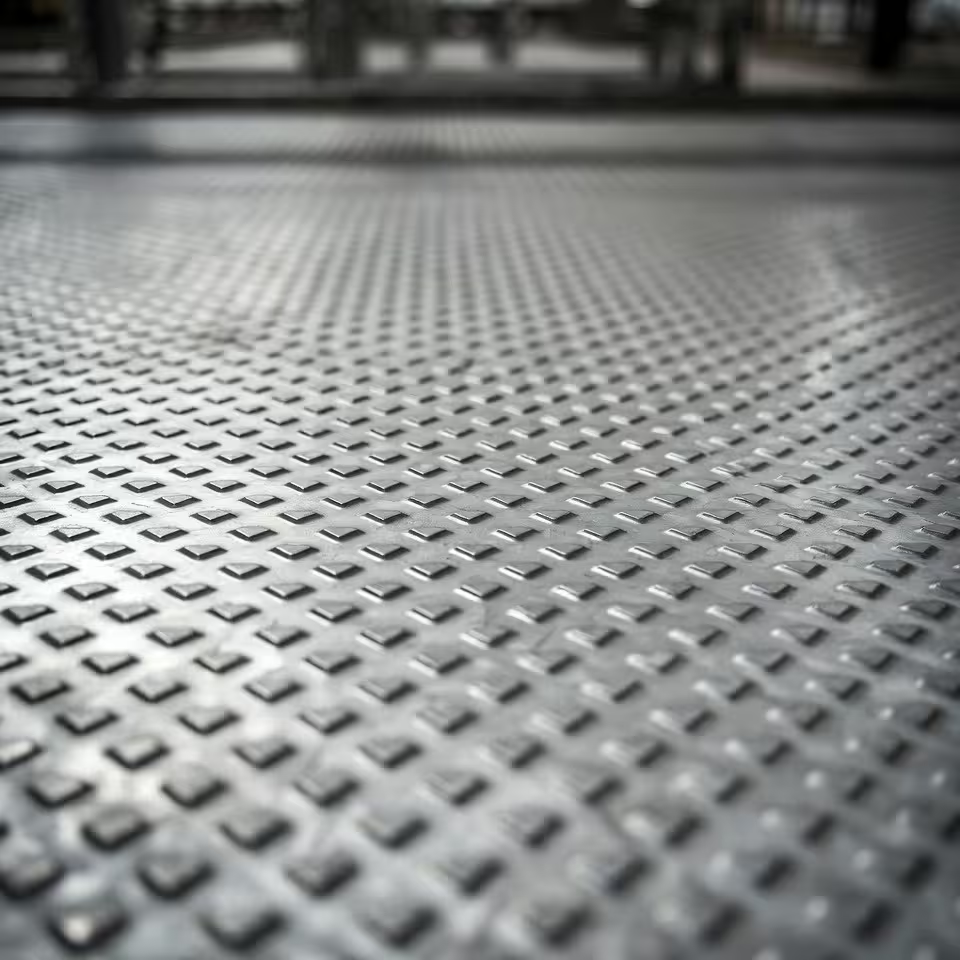
Mezzanine platforms: 0.80–1.00mm BMT, trapezoidal, with anti-slip or chequered surface finish for safety. Loading must be confirmed by structural design.
Renovation and reinforcement: lighter BMT for constrained access; confirm structural adequacy before installation. Often PPGI for aesthetic match to existing building envelope.
Monsoon-heavy regions (Central India): move one step thicker than the minimum for the span, sealed end-laps as standard, minimum 5° roof slope to prevent water ponding.
Installation Tips — Even the Best Deck Sheet Fails When Installed Wrong
Overlap · Fasteners · Support Spacing · Coating Protection
Installation quality is not optional — it is where most deck sheet failures begin. A correctly specified and well-manufactured sheet can still leak, vibrate, dent, or corrode early if installation shortcuts are taken on site. The four most critical installation factors are:
- Maintain correct overlap and alignment: end-laps should be minimum 150–200mm for slopes below 10°, with sealant tape or foam filler on monsoon-exposed roofs. Side-laps must be fastened at the correct spacing. Skewed sheets create continuous water ingress paths that are nearly impossible to fix from inside.
- Use correct fasteners and washers: self-drilling screws must match the sheet thickness (thread pitch and point type vary). EPDM washers must be compressed to the correct torque — over-tightening crushes the washer and creates a leak path; under-tightening leaves the screw unsealed. Torque-limited screwguns prevent both errors.
- Maintain correct support spacing as per profile and thickness: the sheet is designed for a specific maximum purlin spacing. Exceeding this causes mid-span sag, oil-canning, and potential lap seal failure under wind load. Purlin spacing must match the specification — not site convenience.
- Protect coating during handling: scratches made during transport, unloading, and installation expose the base metal to immediate corrosion initiation. Touch up all scratches and cut edges with zinc-rich aerosol paint within 24 hours of installation. Never drag sheets across each other or across abrasive surfaces.
Maintenance, Longevity, and the Real Cost vs Value Picture
Low-Maintenance Not Zero-Maintenance · Lifecycle Cost · Why Cheaper Costs More
Maintenance — Simple but Not Zero
Deck sheets are generally low-maintenance, but that is not the same as maintenance-free. Dirt accumulation in valleys, debris in gutters, water pooling on flat sections, and minor scratch exposure are the starting points for premature corrosion. A quarterly inspection that takes 30 minutes prevents the early corrosion initiation that leads to panel replacement.
Quarterly: clear debris from valleys and gutters; check for water ponding. Half-yearly: inspect fastener compression and sealant condition at overlaps. Annually: touch up scratches and cut edges; inspect all flashing and penetration seals; in coastal/industrial sites, check for early zinc depletion.
Thicker sheets and better coatings reduce maintenance frequency because they are more resistant to denting, coating micro-crack, and fastener fatigue — all of which initiate maintenance needs.
Cost vs Value — The Lifecycle Calculation
Buying deck sheets is not only about the per-sheet or per-kg price. A sheet that saves ₹5/kg at purchase but requires partial re-roofing within 7 years — at ₹200–400/m² installed cost — has returned a negative net saving many times over. The correct comparison is always: total cost over the service life, not day-one procurement price.
Think of it as footwear: cheap shoes may look acceptable on day one but fail at the seam within a year. Quality shoes from a known brand last 5–10 years with basic maintenance. The quality option costs more per pair but significantly less per year of use. Deck sheets work on exactly the same logic — the roofing budget is not the roof cost, it is one input into the 25-year maintenance-inclusive total.
Trusting a reliable supplier like Vishwageeta — who confirms BMT, coating specification, and profile type on the invoice — eliminates the hidden substitution risk that creates most of the market's deck sheet failure stories.
Deck Sheet Selection Checklist — 7 Parameters to Confirm
Application · Profile · Thickness · Material · Coating · Support Spacing · Fasteners
Use this checklist before accepting any deck sheet quote. The logic is simple: more load / longer span / harsher environment = stronger profile + higher BMT + better coating. If any of these seven parameters is missing from a supplier's quotation, the quote is incomplete for comparison.
| Parameter | What to Confirm | Recommended Direction | Common Mistake |
|---|---|---|---|
| Application | Roof / floor / mezzanine / industrial platform / composite slab | Roof → lighter possible. Floor/mezzanine → structurally confirmed thickness. Composite slab → engineer's spec only. | Using a roofing sheet for floor load or composite slab |
| Profile Type | Corrugated / trapezoidal / box-rib / composite deck profile | Corrugated for simple roofing. Trapezoidal for higher stiffness. Box-rib / 51mm rib for composite slabs. | Choosing by appearance rather than structural requirement |
| Thickness | Specify as mm BMT — not gauge, not TCT | Higher load / wider span / more impact → thicker BMT. Never specify by gauge alone. | Accepting a TCT quote without confirming BMT — receiving a thinner sheet than specified |
| Material | Steel (IS 513 / IS 1079) or aluminium | Steel for most structural applications. Aluminium only where weight or unpainted finish is critical. | Not confirming material grade and standard on the invoice |
| Coating | Zinc GSM (Z180/Z275) / Galvalume AZ grade / PPGI paint system | Monsoon/coastal → Z275 minimum or Galvalume. Aggressive environments → PVDF. Match coating to actual site environment. | Accepting "GI" without specifying zinc coating weight (Z180 vs Z275 is a significant lifespan difference) |
| Support Spacing | Confirm maximum purlin/joist spacing supported by the profile and BMT | Always match support spacing to the sheet's design span — do not exceed without respecifying the sheet. | Wide spacing causing mid-span sag, oil-canning, and lap seal failure |
| Fasteners & Accessories | Correct screw type/size, EPDM washer, flashing, foam filler, ridge, gutter | Complete system — sheet + fasteners + accessories + flashing. Skipping accessories creates leak paths. | Wrong screw type causing rust spots at every fastener point from year 2 onwards |
| For composite floor decking, all parameters must be confirmed by a qualified structural engineer. This checklist is for guidance only — final specification must match the structural drawing. | |||
Frequently Asked Questions
Common Questions on Deck Sheet Types, Thickness, Coating & Selection
Vishwageeta Ispat — Raipur, Chhattisgarh
Vishwageeta Ispat is Raipur's trusted iron and steel supplier — stocking galvanized and pre-painted deck sheets across all standard profiles and thickness ranges, TMT bars (IS 1786), MS angles (IS 808), MS pipes (IS 1239), square hollow sections (IS 4923), H-Beams, ISMC channels, and all structural steel products. We provide confirmed specifications and competitive delivered rates across Chhattisgarh and Central India.
Need the right deck sheet for your project? Share your application, span, environment, and delivery location — we'll recommend the correct profile, BMT, and coating, and provide a transparent same-day quote.