The Complete
Binding Wire
Buying Guide
Everything a contractor, site engineer, or steel trader needs to know about binding wire — types, gauge selection (16G to 24G), weight per coil, black annealed vs GI wire, IS 280 standard, price per kg, and how to avoid the quality traps that cost projects money. Free reference by Vishwageeta Ispat, Raipur.
Need current pricing on binding wire coils? Contact us for mill-linked rates.
Send EnquiryFill the contact form Join WhatsApp ChannelDaily rate updatesBinding wire is the most overlooked item in any construction material list — and the most misunderstood one when it comes to procurement. Costing just a fraction of a TMT bar, binding wire is often bought purely on price, from whoever offers the cheapest coil. The result: wire that breaks during tying, coils that are 20% underweight, gauges that are too thin for the rebar being tied, and non-IS material that fails site inspections. This binding wire buying guide explains everything you need to specify, source, and verify binding wire correctly — from gauge selection and IS 280 standard compliance to coil weight verification and the black annealed vs GI decision. Read this once and you will never overbuy, underbuy, or get cheated on binding wire again.
- What Is Binding Wire? — Definition, uses, IS 280 standard
- Types of Binding Wire — Black annealed, GI, hard-drawn, PVC coated
- Binding Wire Gauge Guide — 16G to 24G, diameter, applications
- Binding Wire Weight Chart per Coil — IS 280 reference table
- Black Annealed vs GI Binding Wire — Full comparison
- How Binding Wire Is Used in Construction
- Binding Wire Price Guide — Per kg, per coil, market benchmarks
- Quality Verification Checklist — IS 280 compliance, coil weight fraud
- 7 Binding Wire Buying Mistakes to Avoid
- FAQ — Binding Wire Buying Guide
What Is Binding Wire? The Overlooked Steel Product That Holds Construction Together
Definition • IS 280:2006 • Manufacturing • Why It Matters
Binding wire — also called tying wire, annealed wire, lashing wire, or taar in local parlance — is a thin, flexible mild steel wire supplied in coil form and used primarily to tie and secure reinforcement bars (TMT rebars) at their intersections in reinforced concrete construction. Every slab, beam, column, and footing in a building uses binding wire to hold the rebar cage in its designed position before and during concrete pouring.
Beyond construction, binding wire is used in fabrication shops for temporary clamping, in agriculture for fencing and bundling, in horticulture for plant support, in packaging for baling and strapping, and in general engineering for dozens of fastening applications. This binding wire buying guide focuses primarily on construction and fabrication use — the two largest demand segments in Central India.
How Binding Wire Is Made
Binding wire is manufactured from low-carbon (mild) steel wire rod through a process of wire drawing — pulling the rod through a series of dies of decreasing diameter until the target gauge is achieved. The drawn wire is then subjected to annealing — a heat treatment process that softens the wire, making it flexible and easy to twist by hand without breaking.
Black annealed binding wire gets its dark, matte finish from the oxidation that occurs during the open-furnace annealing process. GI (galvanised iron) binding wire is drawn, then annealed, then passed through a molten zinc bath to apply a corrosion-resistant coating before coiling.
IS 280:2006 — The Governing Standard
IS 280:2006 — "Mild Steel Wire for General Engineering Purposes" — is the primary Indian Standard covering binding wire. It specifies minimum tensile strength, percentage elongation, wire diameter tolerances, and surface finish requirements for different grades of mild steel wire.
For construction use, IS-marked binding wire confirms that the product has been third-party verified by BIS for dimensional accuracy and mechanical properties. Non-IS binding wire may be significantly underweight, have excessive diameter variation, or break during twisting — all problems this binding wire buying guide will help you identify and avoid.
Genuine IS 280-compliant binding wire coils carry a BIS certification mark (the familiar IS logo) on the inner cardboard core or paper wrap. The licence number and manufacturer name should be legible. If a coil has no marking at all — that is the first quality red flag.
Types of Binding Wire — Which One Does Your Project Actually Need?
Black Annealed • GI • Hard-Drawn • PVC Coated • Stainless
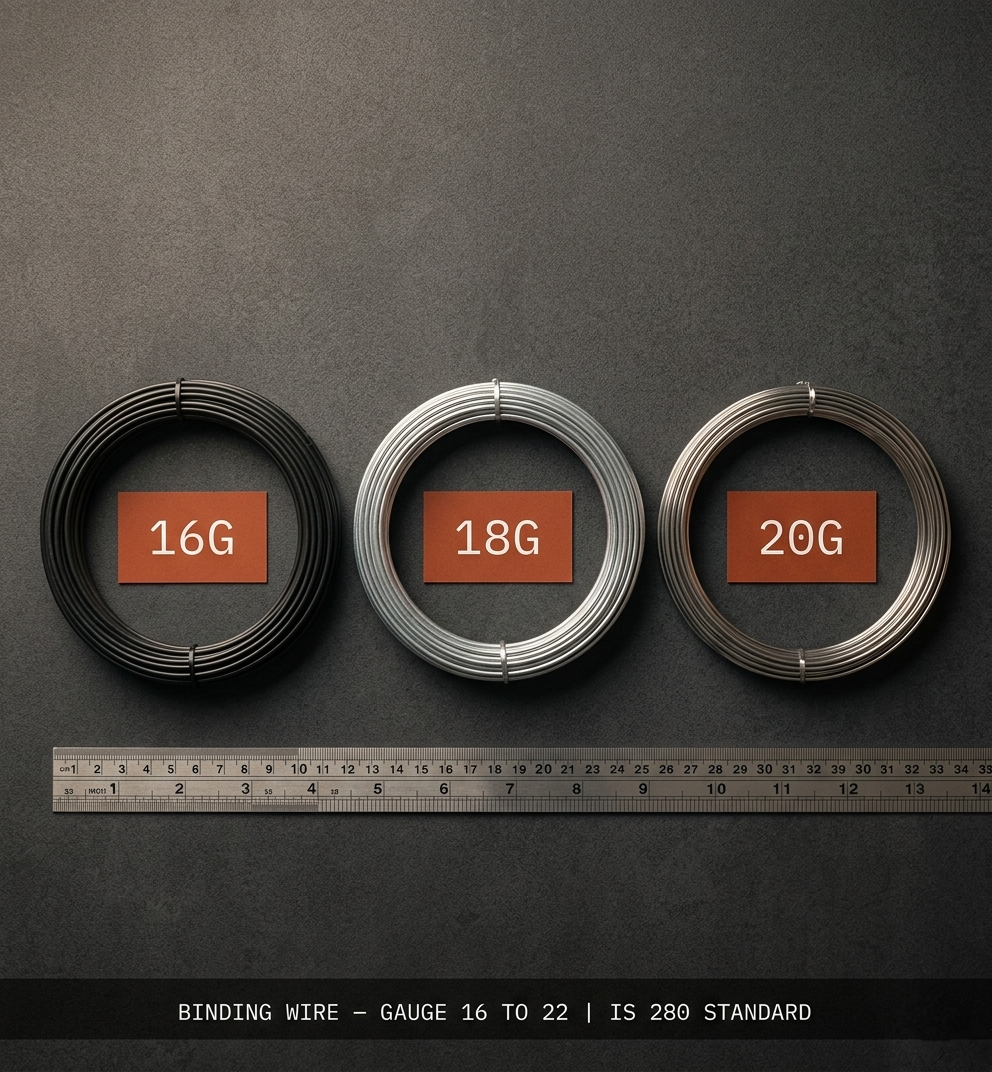
The Indian market offers several types of binding wire, each suited to a different application. Most construction sites use only one type — but knowing all of them helps you avoid buying the wrong product and helps you advise buyers correctly.
Black Annealed Binding Wire
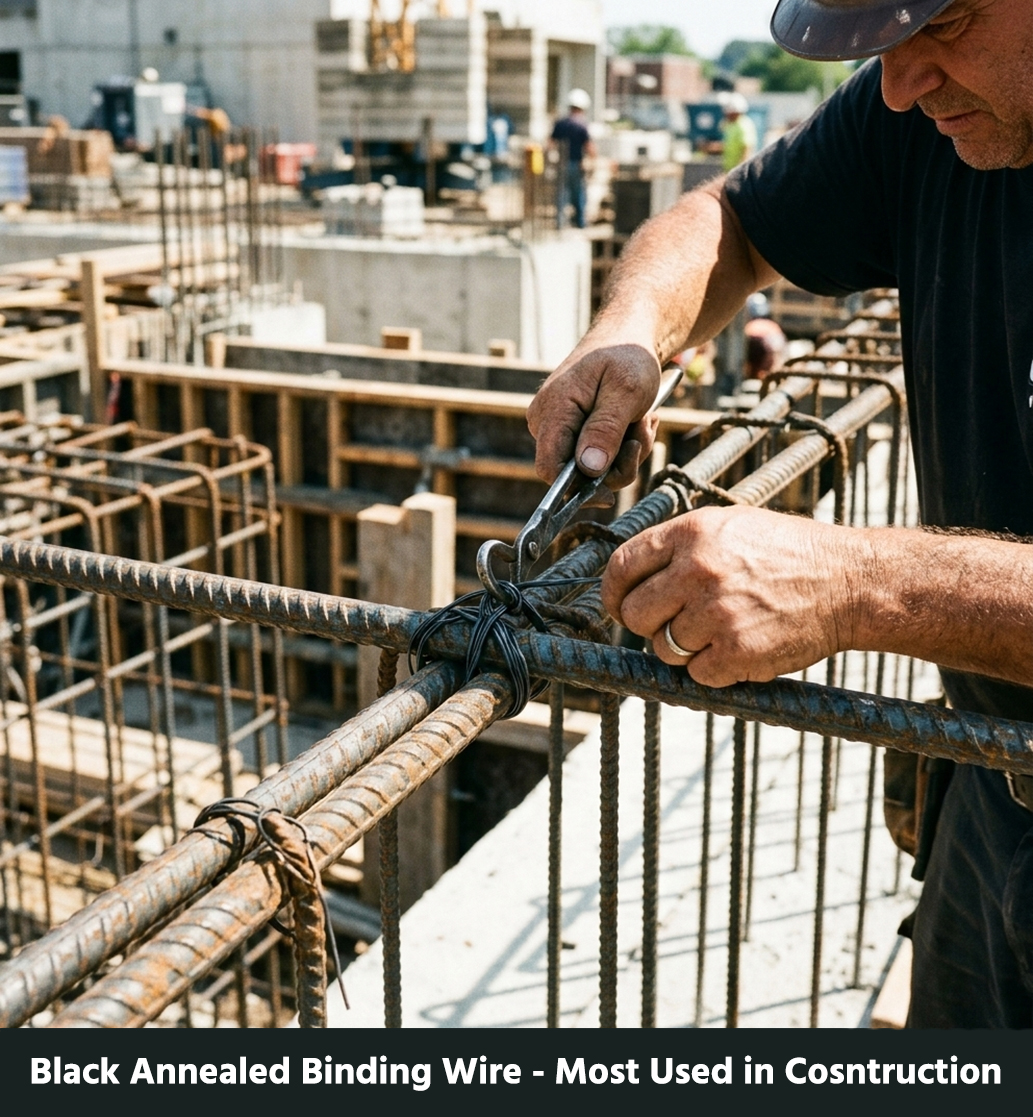
The standard binding wire for Indian construction. Soft, flexible, and easy to twist by hand or with a hook tool (suta). Dark matte finish from open-furnace annealing. Available in 16G, 18G, 20G. Sold in 2kg, 5kg, 10kg, and 25kg coils. Best value for money for RCC work, rebar cages, and general fabrication tying.
GI (Galvanised Iron) Binding Wire
Zinc-coated binding wire with a bright silver finish. Superior corrosion resistance makes it suitable for coastal projects, water retaining structures, drainage systems, outdoor fencing, and any application where the wire will remain exposed long-term. Typically 15–25% costlier than black annealed. Available in gauges 16G to 22G.
Hard-Drawn (Bright) Wire
Not annealed after drawing — retains the cold-worked tensile strength of drawn wire. Stiffer and less flexible than black annealed. Used in spring manufacture, mesh production, pre-stressed concrete (as PC wire in larger diameters), and applications where strength matters more than flexibility. Not recommended for hand-tying TMT bars — too stiff and prone to snapping.
PVC Coated Binding Wire
GI or mild steel wire coated with PVC in green, black, or white. Used primarily in horticulture (plant support), garden fencing, signage, cable management, and decorative applications. Not used in structural construction — the PVC coating is not IS 280 compliant and adds unnecessary cost for rebar tying.
For RCC construction — slabs, beams, columns, footings, retaining walls — the correct default is black annealed binding wire in 16 gauge (16G), purchased in 25 kg coils from an IS 280-compliant manufacturer. Everything else in this binding wire buying guide is about getting this choice right, verifying it, and knowing when to deviate from it.
Binding Wire Gauge Guide — Which Gauge for Which Application?
SWG Gauge System • Diameter in MM • 16G to 24G Selection Chart
Wire gauge is the single most important specification in any binding wire buying guide. In India, binding wire gauge is measured using the SWG (Standard Wire Gauge) system — where a higher gauge number means a thinner wire. This is counterintuitive for buyers used to the metric system, so the table below translates gauge numbers directly into wire diameter in millimetres.
In the SWG system: higher gauge number = thinner wire. A 16G binding wire (1.63 mm diameter) is thicker and heavier than a 20G binding wire (0.91 mm diameter). When a supplier offers "20G binding wire" at a lower price, they are offering a significantly thinner — and weaker — product. Always verify the diameter in mm, not just the gauge number.
| Gauge (SWG) | Diameter (mm) | Tolerance (mm) | Approx. Weight (kg/m) | Coil Types Available | Primary Application |
|---|---|---|---|---|---|
| 14G | 2.03 | ±0.05 | 0.0253 | 10 kg, 25 kg | Heavy rebar bundles, strapping large prefab cage assemblies |
| 16G Most Common | 1.63 | ±0.05 | 0.0164 | 2 kg, 5 kg, 10 kg, 25 kg | Standard TMT rebar tying in RCC slabs, beams, columns, footings |
| 18G | 1.22 | ±0.04 | 0.00922 | 1 kg, 2 kg, 5 kg, 10 kg | Lighter rebar tying (8mm–12mm bars), wire mesh tying, prefab cages |
| 20G | 0.91 | ±0.03 | 0.00513 | 0.5 kg, 1 kg, 2 kg, 5 kg | Fine rebar tying, mesh edge tying, horticulture, light fabrication |
| 22G | 0.71 | ±0.03 | 0.00312 | 0.5 kg, 1 kg | Decorative, thin mesh binding, plant support, craft and hobby |
| 24G | 0.56 | ±0.02 | 0.00194 | 0.25 kg, 0.5 kg | Jewellery wiring, fine crafts, light horticulture — not construction |
Choosing the Right Binding Wire Gauge for Rebar Tying
The correct binding wire gauge for tying TMT rebars depends on the diameter of the bars being tied. Heavier bars require thicker (lower gauge number) binding wire to stay secure under the vibration of concrete pouring.
8mm to 12mm TMT bars: 18G binding wire is adequate for lighter work; 16G is recommended for column cages and footings.
12mm to 20mm TMT bars: 16G binding wire is the standard.
20mm to 32mm TMT bars: 16G or 14G binding wire; double-strand tying recommended at critical intersections.
32mm+ bars: Always use 14G double-strand tying at intersections.
How Gauge Affects Your Binding Wire Consumption
On a typical residential RCC project, binding wire consumption is estimated at 8–12 kg per MT of TMT steel when using standard 16G wire. Moving to 18G reduces consumption weight (thinner wire = fewer kg per tie) but requires more twists per joint to achieve the same holding strength.
The cost saving from buying 18G instead of 16G is often marginal — typically ₹2–5/kg cheaper — but the reduction in joint security on large-diameter bars is real. For most construction procurement, the binding wire buying guide recommendation is: standardise on 16G and buy from IS 280-certified manufacturers.
Use a wire gauge plate or digital vernier caliper to verify diameter. For 16G binding wire, the correct diameter is 1.63 mm ± 0.05 mm. If your caliper reads below 1.55 mm consistently, the wire is under-gauge — likely 18G sold as 16G.
Binding Wire Weight Chart — Coil Weight, Metres Per Coil & Consumption Guide
Coil Weight in KG • Metres of Wire Per Coil • Binding Wire Consumption Estimator
One of the most practical sections of any binding wire buying guide is a clear coil weight and length reference. Knowing how many metres of binding wire a standard coil contains helps you estimate how many coils a project needs — and helps you quickly detect if a delivered coil is underweight.
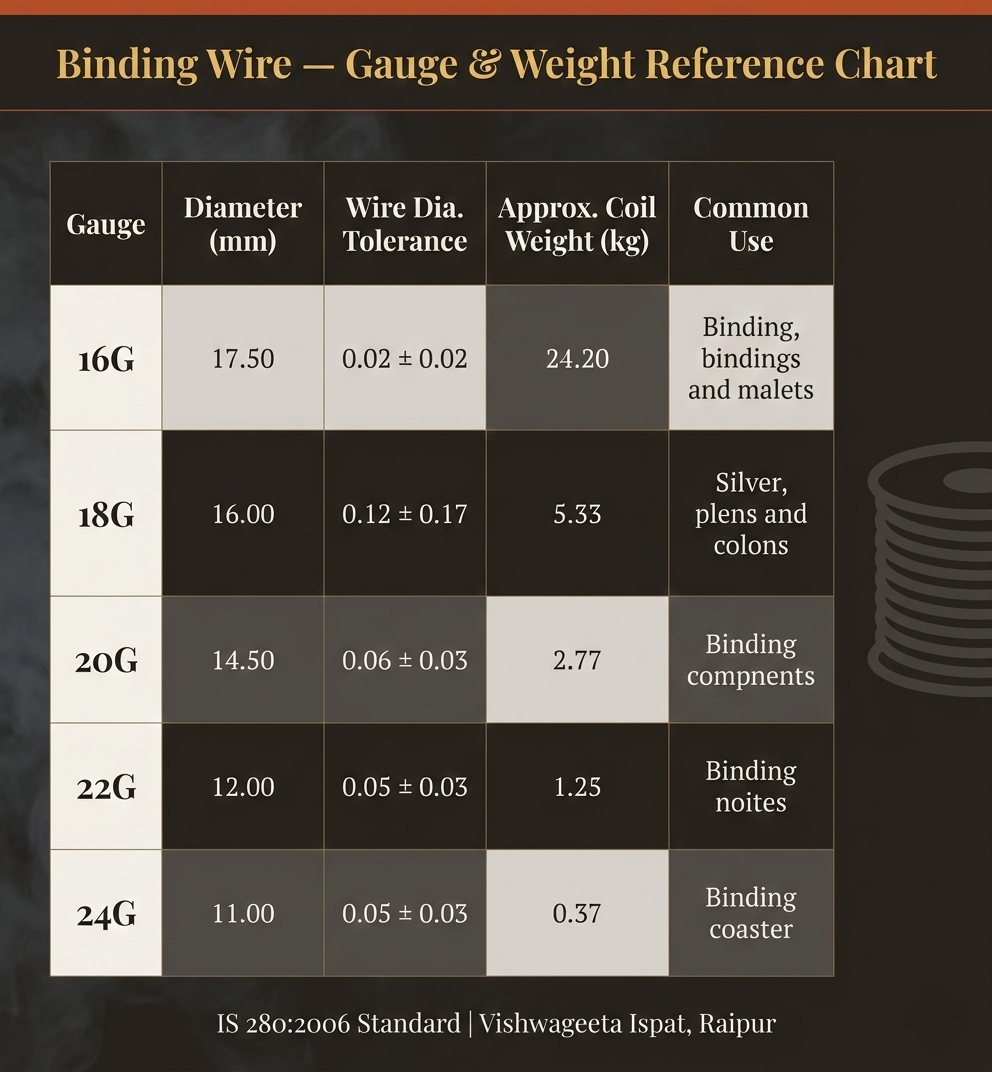
| Gauge | Dia. (mm) | Std. Coil Wts (kg) | Metres / 25kg Coil | Metres / 10kg Coil | Metres / 5kg Coil | Ties / 25kg Coil (est.) |
|---|---|---|---|---|---|---|
| 14G | 2.03 mm | 10 kg, 25 kg | ~990 m | ~396 m | ~198 m | ~3,000–4,000 ties |
| 16G Default | 1.63 mm | 2 kg, 5 kg, 10 kg, 25 kg | ~1,524 m | ~610 m | ~305 m | ~5,000–7,000 ties |
| 18G | 1.22 mm | 1 kg, 2 kg, 5 kg, 10 kg | ~2,713 m | ~1,085 m | ~543 m | ~9,000–12,000 ties |
| 20G | 0.91 mm | 0.5 kg, 1 kg, 2 kg, 5 kg | ~4,878 m | ~1,951 m | ~976 m | ~16,000–20,000 ties |
| 22G | 0.71 mm | 0.5 kg, 1 kg | ~8,013 m | — | — | Light use only |
Rule of thumb: for standard RCC construction with 12–16mm TMT bars, use 8–12 kg of 16G binding wire per MT of steel. For a residential building using 15 MT of TMT bars: 15 × 10 = 150 kg binding wire required = 6 coils of 25 kg each. Add 10–15% buffer for wastage, offcuts, and retying. For slab-heavy projects (more bar intersections per MT), use the 12 kg/MT estimate. For column-heavy projects, 8 kg/MT is typically sufficient.
Black Annealed vs GI Binding Wire — Complete Comparison for Buyers
Cost • Flexibility • Corrosion Resistance • When to Use Which
The most common question in any binding wire buying guide: should I buy black annealed or GI binding wire? The answer is straightforward once you understand where each type performs best. The wrong choice doesn't break structures — but it does cost you unnecessary money in one direction, or exposes you to premature corrosion failure in the other.
Black Annealed Binding Wire
- Extremely soft and flexible — easiest to twist by hand or hook
- IS 280:2006 certified versions widely available
- Most cost-effective per kg — market benchmark price
- Available in every size from small retail to 25 kg commercial coils
- Correct choice for all embedded (concrete-covered) rebar applications
- Dark finish reduces glare — easier to handle in bright outdoor sites
- Rusts if exposed to moisture without concrete cover
- Not suitable for permanently exposed applications
GI Binding Wire
- Zinc-coated — excellent corrosion resistance in exposed conditions
- Suitable for coastal, marine, and humid climate applications
- Brighter finish — easier to visually inspect on site
- Longer service life in permanently exposed fencing and tie applications
- Used in agriculture, horticulture, and outdoor fencing
- 15–25% more expensive per kg than black annealed
- Slightly stiffer — marginally harder to twist in cold weather
- Overkill for standard embedded concrete applications
| Parameter | Black Annealed Binding Wire | GI Binding Wire | Winner |
|---|---|---|---|
| Cost per kg | Baseline (100%) | 115–125% of black annealed | ✔ Black Annealed |
| Flexibility / Ease of tying | Excellent — very soft after annealing | Good — slightly stiffer than annealed | ✔ Black Annealed |
| Corrosion resistance | Low — rusts in exposed conditions | High — zinc coat protects long-term | ✔ GI |
| RCC / embedded concrete use | Perfect — concrete provides protection | Acceptable but unnecessary | ✔ Black Annealed |
| Coastal / marine / exposed | Not recommended | Strongly recommended | ✔ GI |
| Agriculture / fencing | Acceptable short-term | Preferred for longevity | ✔ GI |
| IS 280 availability | Widely available IS-marked | Available IS-marked but fewer brands | ✔ Black Annealed |
For standard RCC construction in Central India: buy black annealed 16G IS 280-certified binding wire. For coastal Andhra / Odisha projects or permanently exposed fencing: buy GI binding wire. Buying GI for a standard inland RCC project is an unnecessary cost premium of ₹8–15 per kg. Buying black annealed for a coastal retaining wall is a corrosion risk.
How Binding Wire Is Used in Construction — Application Guide by Project Type
RCC • Fabrication • Agriculture • Fencing • Prefab
Binding wire is consumed across a wider range of applications than most procurement teams realise. Understanding all the use cases ensures you specify the right gauge and type for each application — and helps avoid the single-coil-for-everything approach that leads to either overkill or under-specification.
RCC Slabs & Beams
The highest-volume use of binding wire. Every rebar intersection in a slab must be tied at alternate intersections (as per IS 456 code). A 100 sqm RCC slab with standard two-way reinforcement may have 1,200–2,000 bar intersections requiring binding wire ties. Standard: 16G black annealed, 25 kg coils per floor.
Columns & Footings
Column cages and isolated footings use smaller bar diameters (10–16mm) at higher density. The circular or rectangular ties that hold longitudinal bars in position are secured with binding wire. Column cage pre-fabrication yards often use 16G in higher quantities than slab work due to the dense tie spacing required by design.
Prefab & Precast
Precast factories use binding wire to assemble rebar cages before pouring. Because precast elements are subject to transport vibration, ties are placed at every intersection (not alternating as in site-cast work), increasing consumption significantly. Precast facilities often standardise on 18G for cage assembly to reduce cost without compromising integrity.
Fabrication Shops
Binding wire is used in fabrication to temporarily clamp and position steel sections before welding. 16G and 18G black annealed are both used depending on section weight. Post-weld, the wire is removed. Fabrication shops typically buy 5 kg or 10 kg coils rather than the 25 kg commercial coils used by construction sites.
Agriculture & Fencing
In rural Chhattisgarh and Madhya Pradesh, GI binding wire is widely used for field fencing (attached to barbed wire or chain link), bundling sugarcane and crops, trellising and plant support, and repairing farm equipment. Gauge 16G and 18G GI binding wire in 5 kg and 10 kg coils are the most common retail format for agricultural use.
Packaging & Baling
Industrial scrap yards, waste paper facilities, cotton ginning factories, and warehouses use binding wire in 14G and 16G for baling compressed materials. The heavier gauge (14G) provides the tensile strength needed to hold dense, compressed bales without the wire snapping under tension. This is typically a bulk consumption application — 100–500 kg coils.
Binding Wire Price Guide — Per KG, Per Coil & What Drives the Market
Price Per KG • Market Benchmarks • What Makes Binding Wire More Expensive
Binding wire price in India is quoted per kilogram at the manufacturer and wholesale level, and per coil at the retail and construction supply level. In this binding wire buying guide, understanding price drivers helps you recognise when a quote is fair and when it is suspiciously low (usually signalling non-IS material or underweight coils).
What Drives Binding Wire Price
Wire rod price: The primary raw material for binding wire is mild steel wire rod (MS wire rod). Wire rod prices at SAIL, JSW, and RINL are the primary cost driver. A ₹1,000/MT move in wire rod price translates to approximately ₹1.00–1.50/kg change in binding wire price.
Annealing cost: The heat-treatment process adds energy cost — coal or gas-fired annealing furnaces are the main energy input. Rising fuel costs from global oil price disruptions (including the current Hormuz crisis) flow directly into annealing cost.
Zinc coating (GI only): LME zinc price is the primary variable for GI binding wire. When global zinc prices spike — as they did in 2021–22 — GI wire prices diverge sharply from black annealed prices.
IS compliance cost: BIS-certified manufacturers carry the cost of regular testing, audit visits, and marked packaging. This typically adds ₹2–4/kg versus non-IS wire from unregistered producers.
Market Price Benchmarks (March 2026)
Black Annealed 16G (IS 280): ₹58–68 per kg
Black Annealed 18G (IS 280): ₹56–65 per kg
GI Binding Wire 16G: ₹75–90 per kg
GI Binding Wire 18G: ₹72–85 per kg
Non-IS generic wire (market): ₹46–54 per kg
Prices are indicative for Raipur/Chhattisgarh market, inclusive of GST at 18%. Subject to change — contact Vishwageeta Ispat for current rates.
The price gap between IS 280-certified binding wire and non-IS generic wire is typically ₹8–14 per kg. On a 150 kg project requirement, this is a difference of just ₹1,200–2,100. Given the quality risk of non-IS wire — breakage during tying, underweight coils — the IS premium is almost always worth paying on any serious project.
Binding Wire Quality Verification Checklist — How to Spot Under-Weight & Non-IS Coils
IS 280 Compliance • Coil Weight Verification • Diameter Check • Site Inspection
This section of the binding wire buying guide is the most practical one for anyone receiving material on site. Binding wire quality fraud is common in the Indian market — primarily in the form of underweight coils (declared 25 kg but actually 22–23 kg), under-gauge wire (declared 16G but closer to 18G in diameter), and non-IS material sold as IS-compliant. Here is how to check all three — on site, in under five minutes per lot.
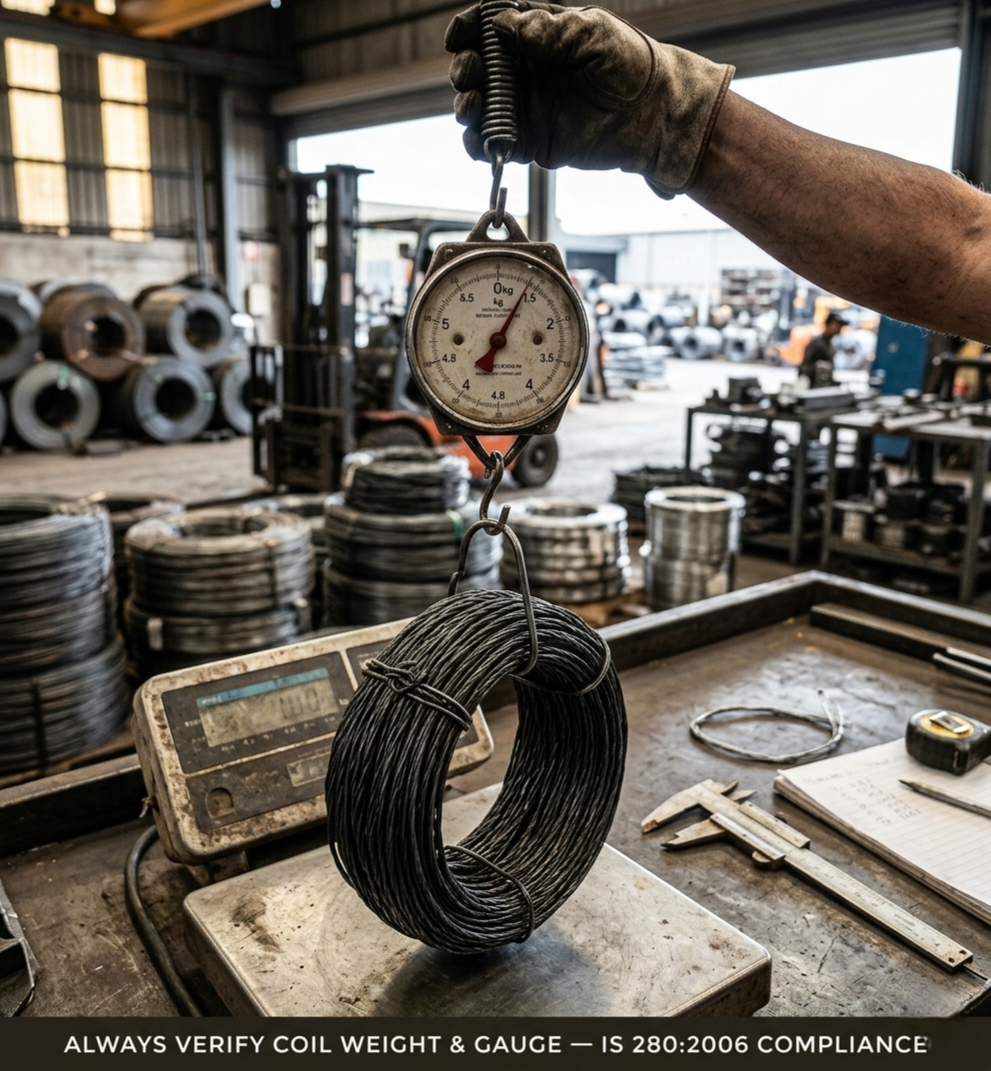
Randomly select 2–3 coils per truck and weigh on a calibrated scale. A declared 25 kg coil should weigh 24.5–25.5 kg (±2% tolerance is reasonable). Coils consistently weighing 22–23 kg represent a 8–10% short-supply on every coil — meaning you are effectively paying for material you are not receiving. Do not accept a full truck without weighing at least 10% of coils.
Pull out 30–40 cm of wire from the coil and measure diameter at 3 points using a digital vernier caliper. For 16G binding wire: correct diameter is 1.63 mm ± 0.05 mm. Readings consistently below 1.55 mm indicate 18G wire sold as 16G. This is the most common form of binding wire fraud in the Indian market.
Inspect the inner cardboard core, outer paper wrap, or any tag attached to the coil. Genuine IS 280-compliant binding wire should show the BIS certification mark, licence number, and manufacturer name. If there is no IS mark — no matter how confidently the supplier claims it is "IS quality" — treat it as non-certified material.
Pull out 15–20 cm of wire and bend it back and forth sharply 10 times at the same point. Genuine annealed binding wire should survive at least 8 full 180° bends without cracking or breaking. If the wire breaks at 3–4 bends, it has not been properly annealed — it will snap during tying on site, increasing wastage and delaying work.
Tie two scrap rebars together with two twists of the wire using a standard hook tool. Properly annealed 16G binding wire should form a tight, secure joint with 2–3 twists without the wire springing back or snapping. Wire that springs back aggressively is under-annealed. Wire that twists too easily and feels like aluminium is likely sub-standard gauge material.
For large project procurements (500 kg+), request a Mill Test Certificate (MTC) from the manufacturer showing: wire diameter, tensile strength (N/mm²), elongation percentage, and IS 280 grade confirmation. Any reputable IS-certified wire manufacturer will provide this without hesitation. If the supplier says "MTC not available," that is a significant quality red flag.
7 Binding Wire Buying Mistakes That Cost Projects Time & Money
Common Errors • How to Avoid Them • Binding Wire Buying Guide Warnings
This binding wire buying guide has been compiled from real procurement experience at construction sites across Central India. These are the seven most common mistakes buyers make — each one avoidable with the knowledge in this guide.
✅ What Smart Buyers Do
- Always specify gauge (16G), type (black annealed), standard (IS 280), and coil weight (25 kg) in the purchase order — never just "binding wire"
- Weigh a sample coil from every delivery before signing the receipt
- Verify wire diameter with a caliper at least once per supplier per project
- Estimate project requirement before ordering — 8–12 kg per MT of TMT is a reliable baseline
- Buy slightly more than estimated — running out mid-pour is expensive and dangerous
- Store coils off the ground on wooden pallets, covered, away from direct rain
- Prefer IS-marked wire from established manufacturers even at a small price premium
❌ What Costs Projects Money
- Buying on price alone without specifying gauge — the cheapest coil is almost always a thinner, lighter gauge than needed
- Accepting non-IS wire because it "looks the same" — physical appearance cannot tell you tensile strength or diameter accuracy
- Buying GI binding wire for standard embedded concrete applications — unnecessary 20% cost premium
- Underestimating project requirement and placing emergency orders mid-project at higher prices
- Storing coils in direct contact with wet concrete floors — accelerates surface rust which weakens the wire
- Using 20G wire to tie 20mm+ TMT bars — the wire will slip under concrete vibration
- Not checking coil weight — a ₹5/kg saving that is really a 10% weight shortfall is actually a cost increase
The single costliest binding wire error — and the one most often overlooked — is using wire that breaks during tying. A worker retying the same joint three times instead of once means your labour cost per tie triples. On a 1,500-joint column cage, the difference between good wire and bad wire can add half a day of labour to the cage assembly schedule.
• Bureau of Indian Standards (BIS) — IS 280:2006 — Mild Steel Wire for General Engineering Purposes
• BIS Civil Engineering Standards — IS 456:2000 Code of Practice for RCC (governs binding wire use in reinforcement)
• Ministry of Steel, Government of India — Wire rod and steel pricing benchmarks
Binding Wire Buying Guide — Most Asked Questions
FAQ • For Contractors, Site Engineers & Steel Traders
Vishwageeta Ispat — Raipur, Chhattisgarh
Vishwageeta Ispat is Raipur's trusted iron and steel stockist — supplying TMT bars, MS angles, ISMC channels, I-beams, MS pipes, square and rectangular hollow sections, MS sheets, chequered plates, and binding wire (black annealed and GI, all standard gauges). This binding wire buying guide is published as a free reference for contractors, site engineers, fabricators, and procurement managers across Chhattisgarh and Central India.
Need current rates on IS 280 binding wire coils? Looking to procure for a full project? Our team will give you mill-linked pricing on certified 16G and 18G black annealed and GI binding wire, with availability confirmation same working day. Mention "binding wire buying guide" for priority service.