MS Channel Weight
Chart (kg/m)
+ Quick Calculator
A practical reference for common MS Channel sizes used in fabrication, sheds, trusses, supports and industrial structures. Estimate kg per meter, 6m weight, and 12m weight fast using the chart and calculator below.
Need MS Channel rates, size guidance, or bulk supply? Send a query or join the channel for live updates.
📋 Send EnquiryGet quote for size + quantity 💬 Join WhatsApp ChannelGet rate updates instantlyWhat is MS Channel?
Mild Steel Channel — Use, Shape and Why Weight Matters
MS Channel is a mild steel section with a U-shaped / C-shaped profile used in structural frames, trusses, sheds, racks, machine supports, purlins, platforms and general fabrication. In the market, buyers often refer to it as C Channel, U Channel, or sometimes by comparable ISMC size references.
The shape looks simple, but the important part is the weight per meter. That single number controls material costing, dispatch planning, handling, and even how cleanly a quote translates into a final invoice. This is why an MS Channel weight chart is useful for contractors, site buyers, fabricators and project estimators.
Quotation Accuracy
Steel is billed in kg or tonne. Converting channel length into total kg reduces rate mismatch at the time of billing.
Transport Planning
Correct weight estimation helps in selecting the right vehicle, loading pattern, unloading manpower and dispatch schedule.
Fabrication Costing
Fabricators use kg/m to estimate cutting, handling, welding and total steel consumption before work starts.
Order Control
Finalizing by size plus total kg is the easiest way to avoid shortage, excess purchase, and site-level confusion.
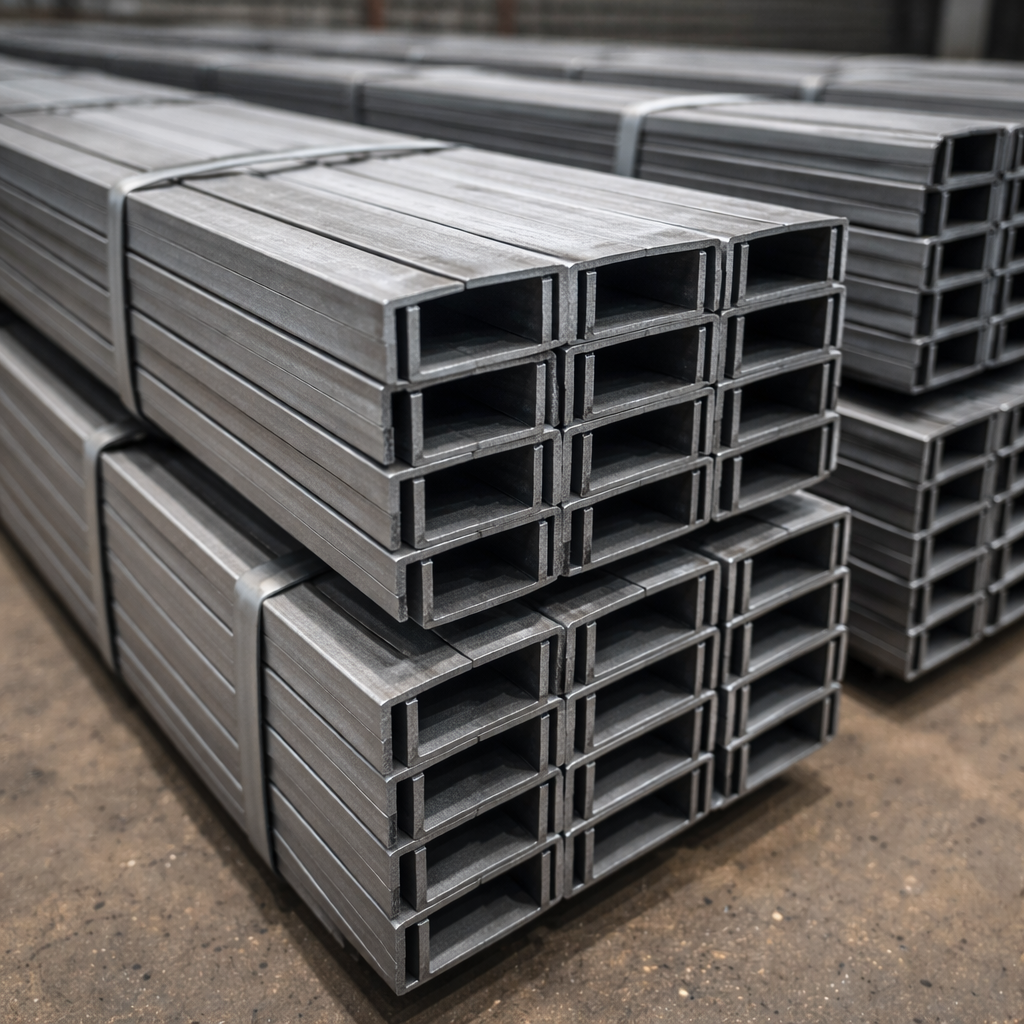
MS CHANNEL SECTIONS STACKED AT A STEEL YARD — COMMONLY USED IN FABRICATION, SUPPORT STRUCTURES AND SHEDS
For larger channel orders, do not finalize only by number of pieces. Always check size + length + total kg. That keeps rate comparison, dispatch and billing aligned.
MS Channel Weight Calculator
Estimate Area, Weight per Meter and Total Weight
Use this calculator for a quick theoretical estimate of an MS Channel section. It is useful for quotation support, BOQ estimation, material planning and dispatch calculations before actual supply.
Weight (kg/m) = Area × 0.00785
Important: this is a quick estimation formula based on a uniform-thickness section. Actual channel weight can vary slightly due to mill rolling tolerances, internal radii, taper and section details.
For a 100 × 50 × 5 mm channel: Area = 5 × (100 + 100 − 10) = 950 mm². Weight = 950 × 0.00785 = 7.4575 kg/m. A 6m length would weigh about 44.745 kg.
MS Channel Weight Chart (Common Sizes)
Estimated kg/m, 6m and 12m Weight for Popular Channel Sizes
The table below covers frequently used channel sizes in fabrication and structural work. These values are built using the same estimation formula shown above, so the calculator and chart stay consistent with each other.
| Product | Size (H×B×t) | Weight (kg/m) | Weight (kg/6m) | Weight (kg/12m) | Typical Use |
|---|---|---|---|---|---|
| MS Channel | 50 × 25 × 4 | Racks, small frames | |||
| MS Channel | 75 × 40 × 4 | Light structural supports | |||
| MS Channel | 75 × 40 × 6 | Heavier fabrication | |||
| MS Channel | 100 × 50 × 5 | Frames, trusses | |||
| MS Channel | 100 × 50 × 6 | Common structural work | |||
| MS Channel | 125 × 65 × 6 | Industrial supports | |||
| MS Channel | 150 × 75 × 6 | Heavier frames | |||
| MS Channel | 200 × 75 × 6 | High load members | |||
| Reference values are theoretical estimates for planning. Actual supplied weight may vary slightly by mill, tolerance and section profile. Verify for critical applications. | |||||
Total Weight (kg) = kg/m × total length in meters. For example, if a channel weighs 11.7 kg/m and you need 48 meters, total estimated weight = 11.7 × 48 = 561.6 kg.
How Builders and Fabricators Use This Chart
Practical Use of MS Channel Weight Data in Site and Workshop Work
Contractors and fabricators use channel weight charts before ordering material, especially when multiple sizes are involved in one job. The chart helps convert a drawing or BOQ into actual kilograms so pricing, dispatch and workshop planning stay controlled.
Procurement
Compare supplier rates fairly by checking the same channel size against the same estimated total weight.
Transport
Plan vehicle load, unloading arrangement and site handling more accurately when total kg is known in advance.
Fabrication
Estimate cutting, welding and steel consumption before fabrication starts, reducing mid-job material shortage.
Budgeting
Translate drawing quantities into realistic steel cost estimates and reduce the gap between estimate and invoice.
Another important point is that steel rates may change daily, but the section’s kg/m remains the base reference. That is why experienced buyers negotiate on rate only after they are clear on the correct size and estimated total weight.
Heavier channel is not automatically better. The correct section depends on design load, fabrication purpose and drawing requirement. Use the chart for estimation, not as a substitute for structural design.
Frequently Asked Questions
Common Queries on MS Channel Weight and Calculation
Vishwa Geeta Ispat
Vishwa Geeta Ispat publishes practical steel reference pages to help contractors, fabricators, project teams and buyers work with cleaner estimates and better material planning.
For current MS Channel pricing, size availability, dispatch support or bulk supply requirements, use the links below.