The Electric Pole That Stands Everywhere
But Goes Unnoticed
A comprehensive field guide to electric pole types, engineering design factors, hidden field stresses, storm performance, and the expanding role of poles in smart urban and industrial infrastructure across India.
Quality-focused pole and RSJ supply with clear commercial terms and coordinated dispatch.
Request Quote24-Hour Response Join WhatsApp ChannelDaily Rate Updates Call: 9200049000Direct Sales LineElectric pole systems quietly carry the daily load of modern life. They support power lines above roads, homes, shops, schools, and factories — yet most people notice this structure only when there is a fault or outage. This guide explains what makes an electric pole a serious engineered asset, not just a tall stick. Covers pole types, design logic, hidden stresses, storm behavior, and the future of poles in smarter infrastructure networks.
- The Electric Pole in Daily Life — Why it's more than a utility item
- Electric Pole Types & Real-World Role — Concrete, steel, wood — selection logic
- Hidden Stress That Most People Never See — Field loading, attachments, corrosion
- Storm & Wind Performance — How poles survive extreme conditions
- Engineering Factors That Decide Safety — Wind zone, foundation, inspection cycle
- Future Role in Smart City Infrastructure — Multi-utility design evolution
- FAQ — Electric Pole Questions Answered
The Electric Pole in Daily Life
Public Asset • Engineered Structure • Everyday Dependency
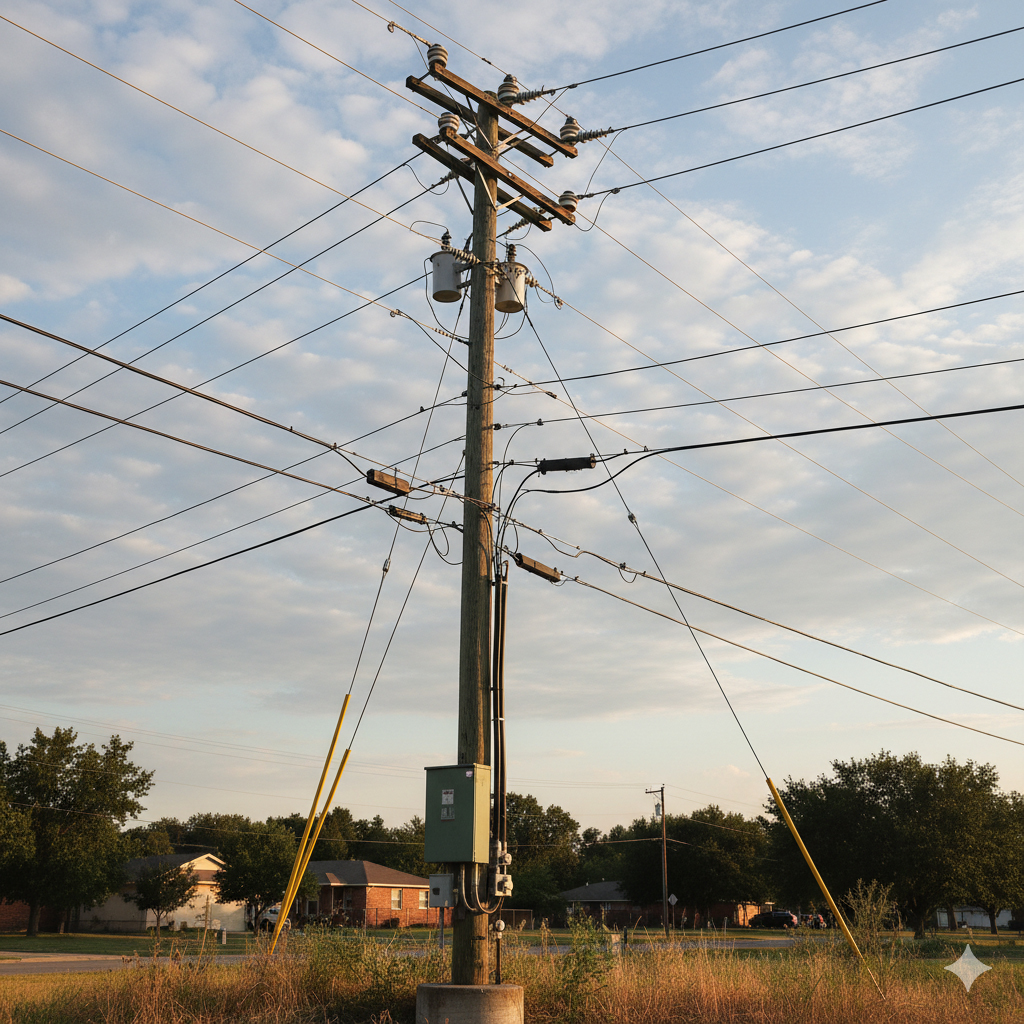
Fig 1 — Electric pole infrastructure supporting reliable distribution across streets, markets, and industrial zones.
An electric pole may look simple, but its job is complex. It must hold cable tension, resist wind, and stay stable across changing weather conditions. In addition, it must maintain correct clearance from vehicles, pedestrians, and buildings at all times. This is not just a tall stick — it is a designed and certified utility asset.
On paper, design values look straightforward. In the field, though, reality is harder. Poles face rain, heat, dust, vibration, corrosion, and unplanned loading from banners, extra cables, and communication equipment. Even then, they continue working day after day — silently holding up the network that powers every home and business below.
That is why material choice, foundation depth, coating quality, and inspection schedules matter far more than most people assume. Cutting corners on any one factor directly affects safety, uptime, and long-term cost for everyone who depends on that network.
Electric Pole Types and Their Real-World Role
Concrete • Steel • Wood — Selection Logic, Strengths & Limitations
No single pole type is perfect for every location. Selection depends on load class, terrain, climate, available budget, target service life, and maintenance access. Here is a practical overview of the three main types used across Indian utility networks.
Concrete Poles
Most Widely UsedKnown for toughness and corrosion resistance. Widely used in LV and MV distribution because they handle weather exposure well across decades. Require correct foundation practice and proper equipment for transport and erection due to their weight. When installed correctly, concrete poles deliver the lowest lifecycle maintenance cost.
Steel Poles
Urban & Industrial ChoiceIncreasingly preferred in urban corridors and industrial zones. Slimmer profile, lower visual width, and highly adaptable to demanding load cases. Require quality surface protection — galvanizing or coating — to prevent corrosion in humid or coastal environments. With correct coating and periodic inspection, steel poles perform exceptionally well with long service life.
Wooden Poles
Legacy / Remote UseStill present in older and remote networks. Lower initial cost in some terrains and simpler erection in select conditions. However, wood ages faster under moisture, pests, and seasonal stress cycles. Many utilities are transitioning from wood to concrete or steel where lifecycle reliability is a higher priority than short-term procurement cost.
| Pole Type | Typical Application | Key Strength | Key Limitation | Typical Life |
|---|---|---|---|---|
| Concrete | Rural & semi-urban LV/MV distribution | Corrosion resistance, low maintenance | Heavy — needs equipment for transport & erection | 40–50 years |
| Steel | Urban corridors, industrial zones | Slim profile, load flexibility | Needs quality coating against corrosion | 30–45 years |
| Wood | Remote or legacy networks | Simpler erection in certain terrains | Faster aging under moisture and pests | 15–25 years |
Hidden Stress That Most People Never See
Unauthorized Loads • Field Damage • Foundation Risk • Inspection Gaps
Field stress on an electric pole is not only electrical. In reality, poles often carry a compounding set of extra burdens that were never part of the original design — and they do so without any complaint until something fails.
Common Unauthorized & Unplanned Loads
- Extra telecom cable loops added without load recalculation
- Banner and poster fastening concentrated at one height band — creating a wind sail
- Accidental vehicle contact near narrow turns and market roads
- Bird nesting around hardware and insulator zones — blocking inspection
- Waterlogging around foundations during monsoon — weakening soil support
- Unauthorized power connections adding weight and vibration
Why Inspection Discipline Matters
A simple inspection cycle can reduce emergency failures and unexpected replacement costs significantly. Preventive maintenance is not optional — it directly improves power continuity and public safety.
Consider: a pole that worked well 15 years ago may not be enough today. Cable count, communication load, and urban density have all increased. Design assumptions made at erection time must be reassessed against current demand to understand the real safety margin remaining.
Early warning signs of an overloaded or damaged pole include visible tilt, surface cracking, rust staining at the base, loose hardware, and unusual vibration. Report or act on any of these immediately — before minor signs become major failures.
Electric Pole Performance During Storm & Wind Pressure
Design Margins • Soil Behavior • Controlled Failure Mechanics
Storm season is the real test of every electric pole. During high wind events, cable swing and dynamic tension increase rapidly. At the same time, wet and saturated soil can weaken the support around foundations — reducing the embedment resistance the pole relies on for stability.
Even so, well-designed poles survive because safety factors are built into section selection, embedment depth, and erection practice. A pole specified for IS Wind Zone IV, for instance, is engineered to a significantly higher bending demand than a Zone I pole — even if they appear identical from the street.
🟩 Why Good Poles Survive
- Safety factors built into section selection for the declared wind zone
- Foundation embedment designed for worst-case soil condition and overturning load
- Controlled failure mechanics — top yielding before complete base collapse in critical zones
- Quality galvanizing or coating protecting against base corrosion that weakens section strength
- Correct hardware and cable attachment — avoiding eccentric loading that creates bending bias
🟨 Why Poles Fail in Storms
- Under-specified section for actual wind zone — no safety margin for gusts
- Shallow foundation or poor soil compaction at erection — base pulls out first
- Corroded base reducing effective section area below design value
- Excess unauthorized loading from banners and extra cables increasing wind sail area
- Soil waterlogging eroding embedment — most common failure mode during heavy monsoon
In critical infrastructure zones, engineers also plan controlled failure behavior. Some designs prioritize top-side yielding instead of complete base collapse. This reduces severe road hazards during extreme events — the pole bends or breaks high rather than collapsing at the base, limiting the zone of danger and enabling faster repair.
Engineering Factors That Decide Electric Pole Safety
Wind Zone • Cable Load • Foundation • Coating • Inspection
Every electric pole that performs well over decades is the product of several design decisions made long before it left the factory. Understanding these factors helps buyers, project engineers, and maintenance teams ask better questions and make better procurement decisions.
| Engineering Factor | Why It Matters | Consequence If Ignored |
|---|---|---|
| Wind Zone Class | Defines bending demand — IS 875 Part 3 zone mapping determines required structural margin | Under-specified poles fail in storms with no warning |
| Cable Load Profile | Impacts deflection, vibration behavior, and connection integrity under dynamic loading | Conductor swing and hardware fatigue increase with under-specified loading |
| Foundation & Soil | Controls long-term tilt resistance and overturning safety — embedment depth is critical | Tilt and collapse, especially after monsoon waterlogging |
| Material Grade | Concrete grade and reinforcement steel, or structural steel section determine strength margin | Premature fatigue, cracking, or yielding under design loads |
| Coating & Protection | Galvanizing or paint quality affects corrosion life, maintenance intervals, and replacement cycle | Base corrosion in steel poles reduces effective section — failure without visible warning |
| Inspection Frequency | Detects cracks, rust, hardware loosening, and tilt before threshold is crossed | Minor issues become major failures — expensive emergency repair and downtime |
Future Role in Smart City Infrastructure
Multi-Utility Poles • Digital Accessories • Evolving Role in Urban Networks
Underground cabling will grow in premium corridors across India's larger cities. Yet overhead pole systems will remain essential for the vast majority of urban, semi-urban, and rural areas because they are more practical to install, inspect, and repair at realistic cost levels. Poles will stay relevant for decades to come.
More importantly, the role of poles is actively expanding. Modern networks use poles as mounting structures for smart devices — surveillance cameras, communication transceivers, streetlight controllers, EV charging signage, air quality sensors, and city monitoring hardware. The electric pole is becoming a smart city node, not just a cable hanger.
Multi-Utility Pole Design
The shift toward multi-utility poles means procurement teams must now specify poles that can handle combined electrical, structural, and digital loads. A pole designed only for 11 kV distribution may not have the mounting provisions, section strength, or ground clearance needed for smart city accessories.
Forward-looking projects now include combined load specifications at the design stage — accounting for current cable loads, future capacity additions, communication hardware weight, and wind sail area from mounted accessories.
What This Means for Buyers Today
For procurement teams sourcing poles for new infrastructure or upgrades, this means specifying for future-proofed capacity — not just current demand. An extra 15% structural margin today can avoid costly mid-life upgrades as networks become denser and smarter.
It also means partnering with suppliers who understand both the structural and application demands of modern pole networks — not just those offering the cheapest ex-yard rate on standard sections. Quality, specification accuracy, and supply reliability are the three critical variables that determine actual project outcome.
The electric pole of 2035 will carry power, fiber, city monitoring hardware, and street lighting control on a single certified multi-utility structure. Projects specifying poles today should account for this evolution in their technical documents — and choose suppliers who can provide both the product and the technical support to execute it.
• Bureau of Indian Standards (BIS) — IS 1139, IS 7321, IS 2905 for pole specifications
• Ministry of Power, Government of India — Distribution network guidelines
• Central Electricity Authority (CEA) — Safety regulations and distribution standards
FAQ — Electric Pole Questions Answered
Common Questions • Practical Answers • Field-Relevant Insights
Vishwageeta Ispat — Raipur, Chhattisgarh
Vishwageeta Ispat supplies electric poles, RSJ, structural steel sections, and utility infrastructure materials to distribution projects, contractors, and government infrastructure agencies across Chhattisgarh and Central India. Our poles are supplied to IS standards with full quality documentation. We provide transparent, landed-cost quotations — no hidden freight surprises.
Whether you are specifying poles for a new distribution network, upgrading an existing corridor, or replacing aging infrastructure, our team provides the product range, technical support, and commercial reliability your project needs. Contact us today for competitive pricing and lead time confirmation.