H Beam Size Chart —
Why It Actually
Matters
An H beam size chart looks like a simple table of numbers. Those numbers decide span capacity, lateral stability, connection geometry, weight, and cost. Read them wrong — or skip the chart entirely — and the mistakes show up after the structure is loaded.
Share section size, quantity, and delivery location — we'll confirm dimensions, kg/m, and ₹/kg rate same day.
📋 Send EnquiryFill the contact form 💬 Join WhatsApp ChannelDaily rate updatesWhy the H Beam Size Chart Actually Matters
More Than a Table · Performance Map · Cost Control · Safety Confirmation
An H beam size chart looks simple. Columns of numbers, rows of section designations. Most buyers glance at it, confirm the size "looks right," and move on. But the chart is not just a product listing — it is a performance map that determines whether the beam you order will actually do what the structure needs it to do.
Section height governs span and bending resistance. Flange width governs lateral stability and connection geometry. Web thickness governs shear capacity and local stiffness. Flange thickness governs compression capacity and weld size. Weight per metre governs procurement cost, freight, crane selection, and dead load on the structure below. Five numbers. Five different structural outcomes. All visible in the size chart — invisible when you order by description alone.
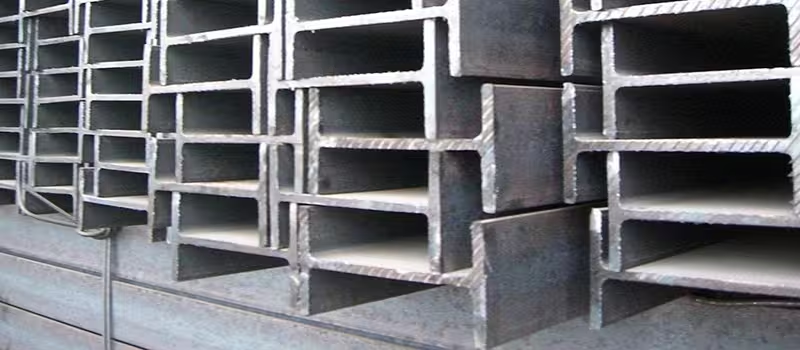
The most common reason for wrong H beam selection is comparing sections by depth alone and assuming dimensions are standard across all suppliers and series. Two beams described as "200mm H beam" from different series can have different flange widths, different web thicknesses, and kg/m values that differ by 15–20%. The chart is the only tool that exposes these differences before the order is placed.
H Beam Anatomy — What Each Dimension in the Size Chart Actually Does
Depth H · Flange Width B · Web Thickness tw · Flange Thickness tf · Weight kg/m
- H — Section depth: the total height of the beam from bottom of lower flange to top of upper flange. Governs span capacity and major-axis bending resistance. The single most important dimension for beam selection.
- B — Flange width: the width of the top and bottom horizontal plates. Wider flanges provide better lateral stability and resistance to lateral torsional buckling. Also determines bolt edge distances in connections.
- tf — Flange thickness: the thickness of the horizontal plate. Governs compression flange capacity, local buckling resistance, and weld leg size for moment connections.
- tw — Web thickness: the thickness of the vertical connecting plate. Governs shear capacity and local web stability under concentrated loads near supports.
- kg/m — Weight per metre: derived from the cross-sectional area × steel density (7,850 kg/m³). The direct cost multiplier and the primary logistics planning input.
Complete H Beam Size Chart — ISHB Series (IS 808)
Section Depth · Flange Width · Web Thickness · Flange Thickness · Weight kg/m
All values from IS 808 for the ISHB (Indian Standard Heavy Beam / Wide Flange) series. These are the standard H-beam sections produced by Indian mills (SAIL, JSPL). For imported wide-flange sections (W-shapes, UC sections), refer to the relevant international standard — dimensions will differ for the same nominal depth.
| Section (ISHB) | Depth H (mm) | Flange B (mm) | Web tw (mm) | Flange tf (mm) | Weight kg/m | Approx ₹/m @ ₹61/kg |
|---|---|---|---|---|---|---|
| ISHB 100 | 100 | 75 | 5.0 | 7.4 | 19.5 | ₹ 1,190 |
| ISHB 150 | 150 | 100 | 5.4 | 7.8 | 24.0 | ₹ 1,464 |
| ISHB 150 (1) | 150 | 100 | 6.9 | 9.0 | 30.6 | ₹ 1,867 |
| ISHB 200 | 200 | 200 | 6.1 | 9.0 | 37.3 | ₹ 2,275 |
| ISHB 200 (1) | 200 | 200 | 7.8 | 10.3 | 45.1 | ₹ 2,751 |
| ISHB 225 | 225 | 225 | 6.5 | 9.1 | 43.1 | ₹ 2,629 |
| ISHB 225 (1) | 225 | 225 | 8.1 | 10.2 | 51.0 | ₹ 3,111 |
| ISHB 250 | 250 | 250 | 6.9 | 9.7 | 51.0 | ₹ 3,111 |
| ISHB 250 (1) | 250 | 250 | 8.8 | 11.1 | 61.3 | ₹ 3,739 |
| ISHB 300 | 300 | 250 | 7.6 | 10.6 | 58.8 | ₹ 3,587 |
| ISHB 300 (1) | 300 | 250 | 9.4 | 11.6 | 70.1 | ₹ 4,276 |
| ISHB 350 | 350 | 250 | 8.1 | 11.6 | 67.4 | ₹ 4,111 |
| ISHB 350 (1) | 350 | 250 | 10.1 | 12.6 | 79.4 | ₹ 4,843 |
| ISHB 400 | 400 | 250 | 8.8 | 12.7 | 77.4 | ₹ 4,721 |
| ISHB 400 (1) | 400 | 250 | 10.6 | 13.5 | 89.1 | ₹ 5,435 |
| ISHB 450 | 450 | 250 | 9.8 | 13.7 | 87.2 | ₹ 5,319 |
| ISHB 450 (1) | 450 | 250 | 11.3 | 15.4 | 101.3 | ₹ 6,179 |
| ISHB 500 | 500 | 250 | 10.2 | 14.7 | 95.0 | ₹ 5,795 |
| ISHB 500 (1) | 500 | 250 | 11.5 | 17.0 | 112.4 | ₹ 6,856 |
| ISHB 550 | 550 | 250 | 11.2 | 15.2 | 104.3 | ₹ 6,362 |
| ISHB 550 (1) | 550 | 250 | 12.0 | 18.2 | 122.0 | ₹ 7,442 |
| ISHB 600 | 600 | 250 | 11.2 | 15.0 | 112.5 | ₹ 6,863 |
| ISHB 600 (1) | 600 | 250 | 12.5 | 18.5 | 133.7 | ₹ 8,156 |
| All values from IS 808. Nominal kg/m — ±2.5% rolling tolerance per IS 1852. Indicative ₹/m at ₹61/kg for April 2026 — adjust for confirmed market rate. GST (18%), loading, and freight are separate. Sub-series (1) = heavier variant with same depth, thicker web and flanges. Request Mill Test Certificate for structural applications. | ||||||
Step 1: Identify the depth (H) your engineer specified. Step 2: Check the flange width (B) — for column applications, B should be close to H. For primary beams, B can be narrower. Step 3: Confirm kg/m matches the section in your drawings — do not substitute based on depth alone. Step 4: Use kg/m × length × pieces ÷ 1,000 = MT for weight and cost estimation. The sub-series (1) sections have the same depth but heavier web and flanges — confirm which variant your design specifies.
How to Read the H Beam Size Chart Without Getting Confused
Depth First · Then Flange · Then Web · Then Weight
The Reading Sequence
1. Start with depth (H): this is the first filter. Depth governs the beam's span capacity and major-axis bending resistance. Your engineer will have specified a minimum depth for the design span and load. Do not select a beam with less depth than specified — do not upgrade to a deeper beam without checking dead load implications.
2. Check flange width (B): for beams with lateral forces or for column applications, flange width is the stability parameter. ISHB 200 (B=200) is more stable laterally than ISHB 300 (B=250) despite being shorter, because the B/H ratio is closer to 1. Wider flanges also provide more space for standard bolt connections.
3. Verify web and flange thickness: the (1) sub-series sections have the same depth as the base section but heavier web and flanges. This changes kg/m by 15–25% and changes section properties significantly. Ordering ISHB 250 when the design specifies ISHB 250(1) is a structural error — not just a weight difference.
Weight Per Metre — the Cost Column
The kg/m column is the procurement team's most important column — it converts depth selection into budget and logistics planning. Two sections that look similar in depth can differ by 20–30% in kg/m. At ₹61/kg and a 100-piece, 9m order, that difference can be ₹10–15 lakh in material cost.
Use kg/m to:
- Calculate total order weight (kg/m × length × pieces = total kg)
- Estimate material cost (total kg × ₹/kg)
- Plan crane selection (per-piece weight for lifting)
- Verify freight requirements (total MT for truck planning)
- Cross-check dead load in structural calculations
Oversizing adds dead load to columns and foundations designed for a specific weight. A beam 20% heavier than specified adds dead load that the structural model did not account for — potentially requiring foundation re-design or reducing the live load capacity of the structure.
How Checking — or Ignoring — the Size Chart Affects Cost
Two Common Errors · Real ₹ Consequences · The Right Approach
| Decision | What Happens Structurally | Direct Cost Impact | Indirect / Hidden Cost |
|---|---|---|---|
| Oversize "for safety" | Higher dead load on columns, connections, foundations | Extra material cost + higher freight cost on every consignment | Possible foundation overload; heavier crane requirement; longer erection time |
| Undersize to save money | Excessive deflection, premature local buckling, connection failure risk | Initial saving negated by structural repair or replacement cost | Downtime, project delay, reputational damage, structural safety risk |
| Wrong sub-series (ISHB vs ISHB(1)) | Structural capacity does not match design — may not be apparent until loaded | Re-procurement and site replacement at full project disruption cost | Engineer liability, safety risk, potential regulatory non-compliance |
| Chart-based correct selection | Performance matches design; dead load, connections, and capacity all correct | Optimal material cost — no overspend, no risk of underspend | Predictable lifecycle cost, no surprises after loading |
Common Mistakes People Make with H Beam Size Charts
Depth-Only Selection · Sub-Series Confusion · Chart Mismatch · Visual Comparison
Selecting by Depth Alone
Ordering "300mm H beam" without confirming flange width, web thickness, and kg/m. Two H beams with 300mm depth — ISHB 300 (58.8 kg/m) and ISHB 300(1) (70.1 kg/m) — have substantially different structural properties. Depth is only the starting filter.
Ignoring Sub-Series (1) Designation
ISHB 250 and ISHB 250(1) have the same 250mm depth but different flange and web geometry. The (1) variant weighs 20% more and has higher section modulus. Confusing them produces either structural under-capacity or significant over-spend — both avoidable with a chart check.
Using the Wrong Standard's Chart
Using a European IPE/HEA chart, a British UC/UB chart, or an American W-section table for ISHB procurement produces wrong dimensions and wrong kg/m for every row. India's ISHB series to IS 808 has its own flange width and thickness proportions. Match chart to standard.
Skipping the Chart for "Standard" Sizes
Assuming that "everyone stocks 200mm H beam" means a single standard section. In practice, different suppliers may stock different variants or sub-series. Confirming from the chart before placing the order takes 2 minutes and prevents a 2-week replacement delay.
Selecting the Right H Beam Size by Application
Columns · Primary Beams · Crane Girders · Industrial Sheds · Wide Spans
Column Applications
Columns carry primarily axial (compressive) loads with some biaxial bending. For column use, select a section where flange width (B) is close to depth (H) — giving a "square" cross-section with nearly equal stiffness in both axes. ISHB 200, ISHB 225, ISHB 250 (where B ≈ H) are the most suitable column sections in the ISHB range. For taller columns in multi-storey structures, ISHB 300 and above are used — confirm the effective length and slenderness ratio with the structural engineer.
Crane Runway Girders
Crane girders must resist both vertical load (lifted weight) and horizontal lateral load (crane side thrust). Deep sections (ISHB 400, 450, 500) with adequate flange width provide the required bending resistance and lateral stability. Always follow the crane manufacturer's structural specification — crane loads are dynamic and fatigue-governed.
Primary Beams and Wide-Span Frames
Primary beams in industrial sheds and portal frames are typically loaded in the strong (major) axis — vertical gravity loads and wind uplift. For spans of 12–20m, ISHB 300, ISHB 350, ISHB 400 are the common range. Lateral torsional buckling is the critical design check for deep, laterally unbraced beams — confirm the unbraced length against the section's LTB resistance.
Warehouse and Mezzanine Structures
Warehouse primary columns: ISHB 200(1) to ISHB 250 at 6–9m column height. Mezzanine primary beams: ISHB 200 to ISHB 300 depending on span and loading. Secondary beams (transferring load to primary): ISMB I-beams are often more economical for mezzanine secondary members. The H beam size chart helps compare options before committing to a structural system.
Quick Checklist Before Ordering H Beams
6 Confirmations That Prevent the Most Expensive Ordering Errors
- Application confirmed: column / primary beam / secondary beam / crane girder / portal rafter — each has different governing criteria for size selection.
- Section designation confirmed from drawings: ISHB 250 vs ISHB 250(1) are different sections. The full designation — including sub-series, depth, and flange width — must match what the structural drawing specifies.
- kg/m from IS 808 chart confirmed: verify the weight per metre for the exact section designation before accepting a quote. This is the cost multiplier — ₹ per tonne × total kg = material cost.
- Flange width (B) confirmed: particularly important for columns, moment connections, and structures in wind/seismic zones where lateral stability is a design parameter.
- Quote terms confirmed: ex-works rate + GST (18%) + loading (₹250–300/MT) + insurance + freight = total delivered cost. Compare total delivered cost, not ex-works headline rate.
- Structural engineer sign-off for critical structures: any beam used in a crane bay, multi-storey frame, bridge, or seismic zone must have the final size confirmed by a qualified structural engineer.
Frequently Asked Questions
Common Questions on H Beam Size Chart, Dimensions & Selection
Vishwageeta Ispat — Raipur, Chhattisgarh
Vishwageeta Ispat is Raipur's trusted iron and steel supplier — stocking MS H-Beams (ISHB series, IS 808) across all standard sizes, ISMB I-Beams, ISMC channels, MS angles, TMT bars, MS pipes, square hollow sections, and all structural steel products. We provide IS 808-consistent dimension data, mill test certificates on request, and competitive delivered rates across Chhattisgarh and Central India.
Need the right H beam size for your project? Share section designation, quantity, and delivery location — we'll confirm the kg/m from the IS 808 chart, current ₹/kg rate, and dispatch timeline same working day.