The Often-Ignored
Importance of a
Current Pole
A current pole looks simple from the road. It is tall, slightly weathered, with wires hanging in controlled tension. Almost nobody thinks about how much this one structure actually does — until something goes wrong.
Share pole height, load requirement, and quantity — we'll confirm section, weight, and ₹/piece rate same day.
📋 Send EnquiryFill the contact form 💬 Join WhatsApp ChannelDaily rate updatesWhat a Current Pole Really Does — and Why It Gets No Credit
Electric Pole · Utility Pole · RSJ Pole · Overhead Line Support
Current pole is the everyday term most people in India use for an electric pole or utility pole. It stands somewhere between being extremely noticeable and completely invisible. It is tall, sometimes slightly bending, with wires hanging in controlled tension — yet almost nobody actually thinks about how much this one structure does. Everything from home lighting to shop boards to industrial circuits begins from the support these poles provide.
The job appears simple from the outside, but nothing about a current pole is actually simple. It keeps high-voltage lines elevated so they don't touch the ground. It maintains alignment from one pole to the next. It handles wind load, cable tension, temperature changes, and even vibrations caused by long-distance power movement. If one pole leans a little too much, the wires start dragging. If it tilts the other direction, the wires stretch hard enough to snap during storms. The structure has to stand steady for years without making any noise about the work it does.
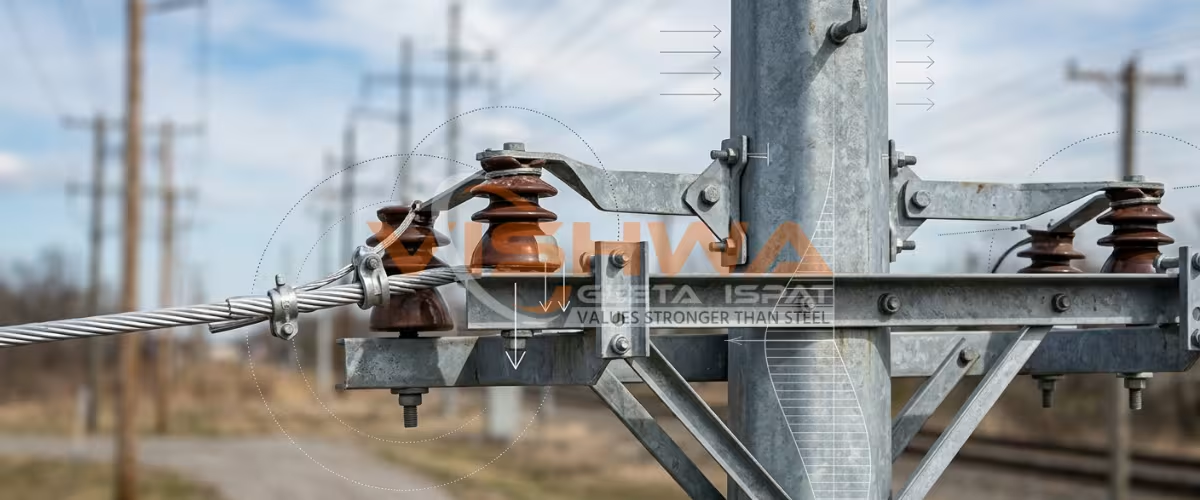
Choosing the Right Material for a Current Pole
Steel · Concrete · Wood · Composite · RSJ · Service Life
Current poles are manufactured from concrete, steel (RSJ), wood, or composite materials. Each material handles the same job differently, and each carries its own long-term trade-offs that affect service life, maintenance frequency, and failure mode.
Concrete poles are rigid and commonly used in Indian distribution networks. The risk is internal cracking — hairline cracks can propagate through the prestressed section without surface evidence, making condition assessment difficult without specialised inspection equipment.
RSJ steel poles are fabricated from rolled steel joist sections. They are lighter than concrete poles of equivalent strength, easier to transport and erect, and can be visually inspected for corrosion at any time without equipment. A proper galvanising or paint system significantly extends service life in most environments.
Wooden poles still exist in older parts of towns and rural networks. Insects and moisture reduce cross-sectional strength gradually — often invisibly until the pole fails under load.
RSJ poles offer three practical advantages over concrete in urban utility work: lower transport weight per unit, faster installation with standard equipment, and visual corrosion inspection without specialist tools. For Vishwageeta Ispat, RSJ pole dimensions and section weights are confirmed to IS specifications before dispatch, giving project engineers reliable load data at the procurement stage.
| Material | Strength | Key Risk |
|---|---|---|
| RSJ Steel | High, predictable | Surface corrosion if uncoated |
| Prestressed Concrete | High, rigid | Internal cracking — invisible |
| Wood | Moderate | Insects, moisture — gradual |
| Composite | Moderate–high | Installation precision critical |
The Height of a Current Pole Is Always More Critical Than It Looks
Ground Clearance · Sag Band · IS 5613 · Wind Moment
Most people assume a taller pole always means better performance. Height selection is actually a calculated trade-off. If the current pole is too tall, the wires start pulling harder than the section can handle at the base. If the pole is too short, the wires sag dangerously low — especially in summer when metal conductors expand and the natural sag increases further.
IS 5613 specifies minimum ground clearance values for different voltage levels and locations. For a distribution line crossing a road in an urban area, the clearance minimum is higher than for a rural agricultural land crossing. Even one wrongly sized pole in a straight line disturbs uniform tension and forces unnecessary pressure on the next few poles — causing early maintenance needs or unexpected tilting across multiple spans.
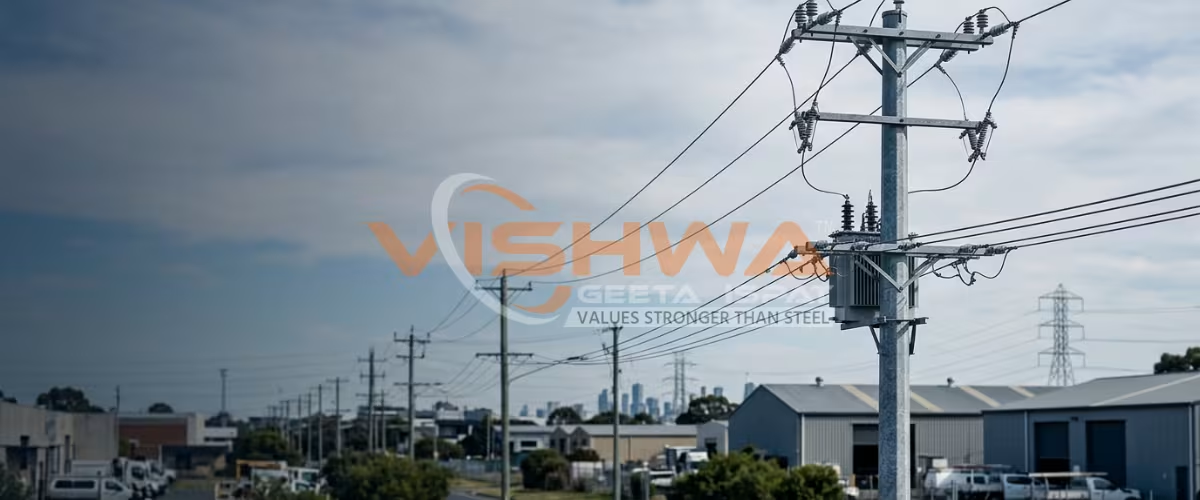
A conductor that meets clearance requirements in January can fail the same check in May. Thermal expansion in summer increases conductor sag by 15–25% compared to winter values. Pole height and span calculations must account for the maximum operating temperature sag, not just the installed sag at ambient temperature. This is why pole height specifications in design drawings include a temperature-based sag analysis, not just a static clearance number.
The Foundation Is the Most Powerful but Most Hidden Part
Soil Bearing · Foundation Depth · Compaction · Waterlogging
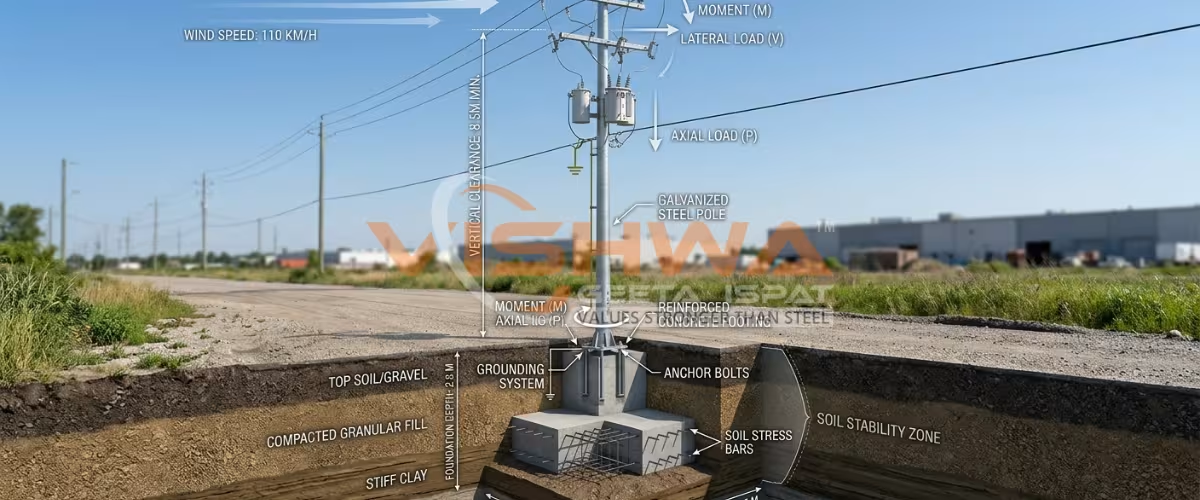
The portion of the current pole above ground gets all the attention. The part that decides long-term stability is buried inside the soil. A shallow foundation or poorly compacted backfill leads to gradual tilt. Waterlogged soil reduces bearing capacity and allows the pole base to rock under repeated wind loading. Rocky ground needs precise drilling — otherwise stress concentration around the pole base causes cracking in concrete sections or accelerated corrosion in steel sections at the soil-air interface.
This is why foundation depth and soil preparation receive as much attention as pole section selection in a properly engineered distribution line. A strong pole on a weak base still loses stability — typically over 5–10 years rather than immediately, which means the failure connection to installation quality is often missed.
Foundation Depth Guidelines
- Standard distribution poles (8–11m): foundation depth = pole height ÷ 6, minimum 1.5m
- Tension poles and angle poles: deeper foundation required — calculate from lateral load
- Soft or waterlogged soil: increase depth or use concrete surround for stability
- Rocky ground: drill precisely to avoid stress concentration at pole base
- Backfill: use well-compacted granular material — not loose excavated soil
In a survey of leaning or fallen distribution poles in Central India, foundation-related causes account for the majority of premature failures — ahead of material defects or overloading. Periodic soil condition checks around the base, especially after monsoon flooding, are more cost-effective than post-failure replacement.
What Weather and Seasons Do to a Current Pole Over the Years
Thermal Expansion · Monsoon · Wind · Corrosion · Fatigue
The current pole stands in harsh sunlight, sudden rainstorms, winter cold, and dusty winds without any shelter. Sunlight expands metal components during the day; night cold contracts them again. This daily thermal cycling creates micro-fatigue at connection points, crossarm bolts, and stay wire anchors over years.
Monsoon rain softens the soil around the base, allowing the pole to rock slightly under wind load. This rocking gradually widens the foundation hole, reducing lateral support. Strong winds — particularly the pre-monsoon storms common across Chhattisgarh and Central India — apply sudden lateral force that the cumulative foundation loosening makes harder to resist.
Corrosion — the Silent Reducer
Uncoated mild steel in a normal urban environment loses 0.1–0.2mm of section thickness per year to corrosion. At the soil-air interface — where moisture, oxygen, and salt concentration are highest — the rate is 2–4× faster. For a steel RSJ pole with 6–8mm flange thickness, this represents a meaningful structural reduction over a 15–20 year service life without protective maintenance.
A proper coating system — zinc-rich primer plus finish coat — applied at manufacture and touched up at 5–7 year intervals dramatically extends service life. The cost of coating maintenance is a fraction of the cost of pole replacement, foundation repair, and line downtime combined.
Wind Load — Often Underestimated
Wind load on a current pole is not just the force on the pole section — it includes the wind force on all attached conductors, crossarms, and accessories. Adding telecom cables, fibre bundles, or CCTV arms after the original installation increases the wind-exposed area significantly. A pole designed for 3 power conductors may be carrying 6–8 lines of various types after 10 years of gradual additions — with nobody having checked the cumulative wind load.
How Current Poles Get Overloaded — and Why Spacing Is Never Random
Unauthorised Attachments · Cumulative Load · Span Engineering
Overloading Without Anyone Noticing
A current pole designed to carry only electric cables gradually becomes support for broadband wires, communication fibre, CCTV cameras, street light arms, and sometimes banners or festival decorations. Every addition seems small to the person adding it. Collectively, the total weight increases, the wind-exposed area grows, and the bending moment at the base rises — often well beyond what the original design accounted for.
The pole can handle only a certain amount of added load before alignment shifts or service life reduces — frequently without obvious warning until a storm event reveals the accumulated weakness. Unauthorised attachments are one of the leading causes of premature pole failure in Indian urban distribution networks.
Spacing Is Always Engineered
Look at any power line. The distance between current poles looks routine, but it is the result of specific engineering calculations. Longer spacing means cables hang too low — failing clearance requirements under maximum sag conditions. Very short spacing makes wires tight and more likely to break during thermal contraction in winter or wind-induced vibration.
Spacing is calculated from: cable weight per unit length, design wind speed for the zone, maximum allowable sag, minimum ground clearance, and conductor mechanical tension limits. One miscalculated span in one stretch forces adjustments in the next few spans, multiplying maintenance issues across the entire route. The IS 5613 series provides the calculation framework used for distribution line span design in India.
A single span that is 15% longer than design causes the conductor to sag lower than the clearance requirement under maximum temperature conditions. To compensate, the next pole must be taller — or the span shortened — or the conductor re-tensioned. Each correction propagates requirements to adjacent spans. This is why span decisions are made at the route design stage, not adjusted pole by pole in the field.
Modern Current Poles Carry More Than Just Power — and the Future Is Busier
Smart City · Fibre · 5G · Sensors · Multi-Utility Infrastructure
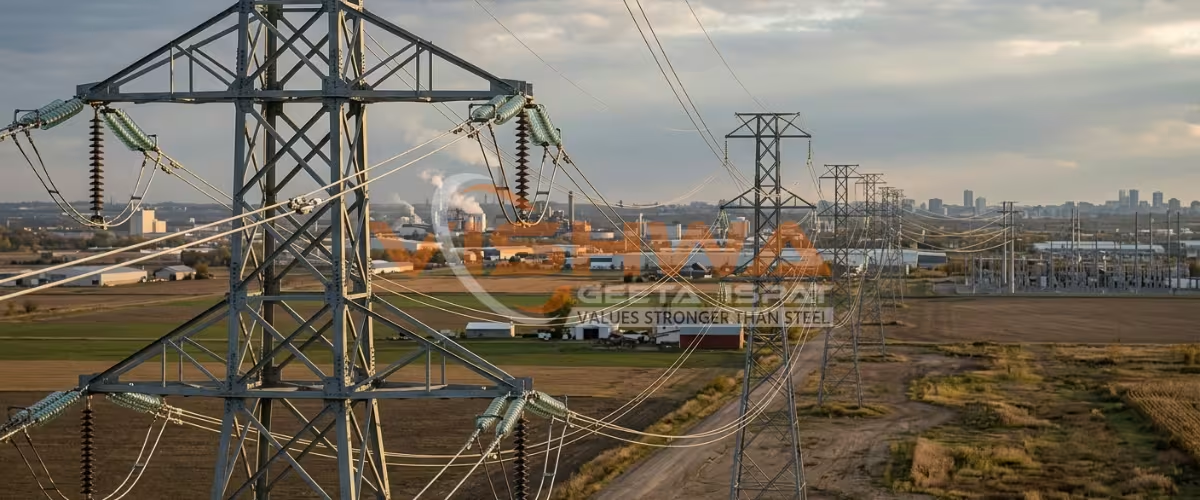
What Modern Poles Carry Today
Today's expectation from a current pole is significantly higher than the original design intent. A single pole in an urban area may simultaneously support:
- LT and HT power conductors
- Broadband and fibre optic cables
- 4G/5G small-cell antennas
- LED street lighting arms
- CCTV cameras and mounting brackets
- Environmental monitoring sensors
- Public address system cables
This evolution from single-purpose power support to multi-utility infrastructure node has happened gradually in most towns — without the poles being redesigned or structurally reassessed for the increased load.
What Smart City Projects Are Demanding
Smart city projects across India are now specifying poles from the outset as multi-utility supports — with structural capacity, arm attachment points, and cable management systems designed for all planned loads simultaneously, not added incrementally.
This means RSJ steel poles for smart city applications are heavier-section than traditional distribution poles, with galvanised finish, pre-drilled attachment brackets, and cable management channels. Vishwageeta manufactures poles keeping future capacity in mind so the infrastructure does not become structurally inadequate within a few years of installation.
A current pole in the near future may not just support power — it may be a passive infrastructure node carrying power, data, sensing, and emergency communication simultaneously from a single engineered point.
Practical Checklist for Current Pole Installation or Inspection
6 Points That Prevent the Most Common Pole Failures
- Confirm total planned load: power conductors today plus likely future additions (telecom, CCTV, lighting arms). Design the pole for the 10-year load, not just today's requirement.
- Verify route clearance: confirm minimum ground clearance per IS 5613 for the voltage level and crossing type. Account for maximum temperature sag, not just installed sag.
- Assess soil condition before installation: confirm bearing capacity, drainage, and groundwater level. Use concrete surround or increased depth for soft or waterlogged soil.
- Confirm span layout and pole spacing: calculate from cable weight, design wind speed, sag limit, and clearance requirement. Do not adjust spans in the field without recalculating the adjacent spans.
- Plan corrosion protection for steel poles: zinc-rich primer plus finish coat at installation; inspection and touch-up every 5–7 years in normal environments, every 2–3 years in coastal or industrial areas.
- Schedule periodic alignment checks: inspect for lean, foundation loosening, and unauthorised attachments. Do not wait for visible tilting — by that point, the structural margin is already significantly reduced.
Frequently Asked Questions
Current Pole — Load, Safety, Foundation & Applications
Vishwageeta Ispat — Raipur, Chhattisgarh
Vishwageeta Ispat is Raipur's trusted iron and steel supplier — manufacturing and supplying RSJ electric poles, MS sections, TMT bars, structural steel, and all utility steel products. We supply with confirmed IS specifications, reliable dimensions, and competitive delivered rates across Chhattisgarh and Central India.
Need RSJ poles or structural steel for a utility or infrastructure project? Share pole height, load requirement, and quantity — we'll confirm section size, weight per piece, current ₹/piece rate, and dispatch timeline same working day.