H BEAM VS I BEAM: WHY THIS COMPARISON CONFUSES PEOPLE EVERY TIME
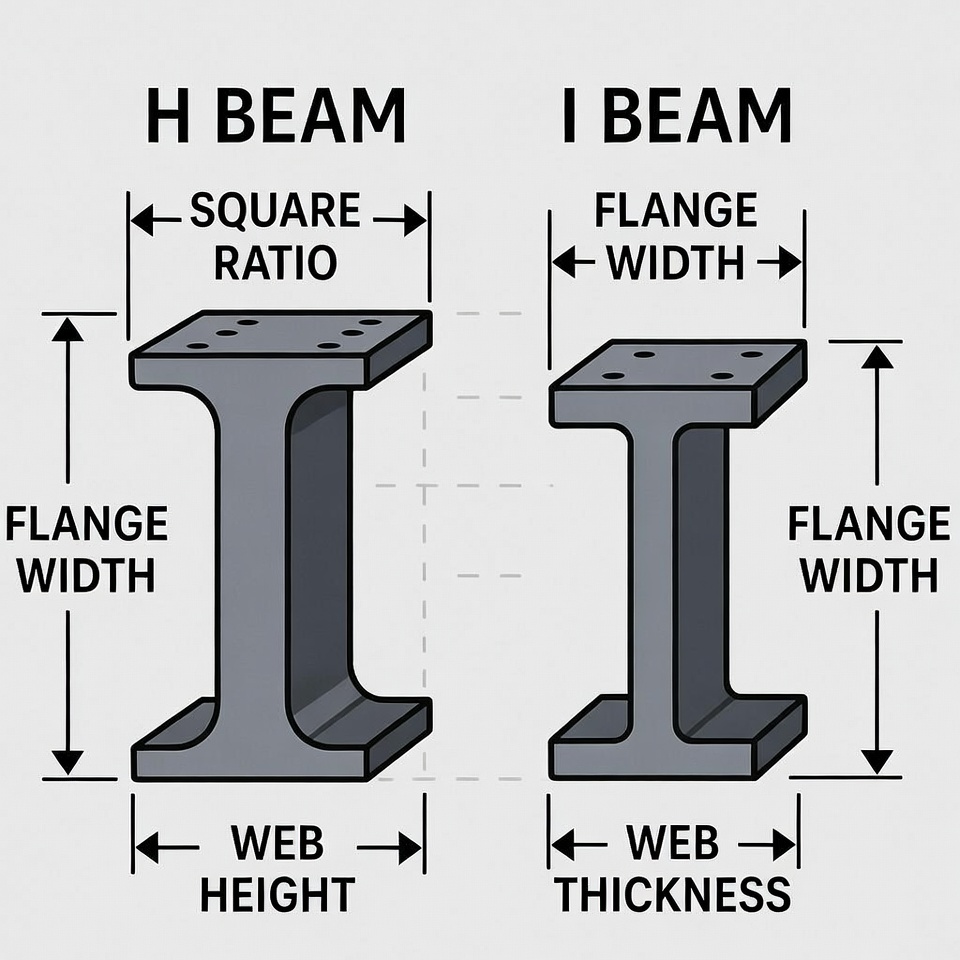
From far they look similar. Up close, flange and web geometry change stability, load distribution, and best-use cases.
Quick Navigation
- Why h beam vs i beam confuses buyers
- Shape differences that change everything
- Why H beams often suit heavy duty
- Where I beams fit better
- How load moves inside each beam
- Why size matters more than the letter shape
- Cost confusion and wrong buying logic
- Installation and handling on site
- Modern design trends affecting both
- Which one to use: real decision method
- Quick selection checklist
- FAQs
The h beam vs i beam debate keeps showing up because it never has one universal answer. From a distance, both sections look similar, but the geometry changes how a structure behaves under load. Many buyers assume an I-beam is just a slimmer H-beam—then they order the wrong one and only realise it when beams are placed on site.
Manufacturers like Vishwageeta (Vishwa Geeta Ispat) see this confusion regularly, especially when selection is done by “looks strong” instead of comparing sizes, load needs, and site conditions.
THE SHAPE THAT CAUSES MOST OF THE DIFFERENCE EVEN BEFORE THE LOAD STARTS
In many series, an H-beam has wider, more uniform flanges that give a more “boxy” profile. Many I-beams use narrower or tapered flanges, which often makes them lighter. This small geometry shift creates different stability and load patterns.
Even a few millimetres difference in flange width and thickness can change how the steel resists bending, twisting, and lateral pressure.
WHY H-BEAMS USUALLY HANDLE MORE AND SPREAD LOAD BETTER
H-beams often suit heavy-duty zones because the wider flanges provide better balance and distribute load more evenly. This can reduce concentrated stress, especially in longer spans and high-load frames.
- Commonly preferred for factories, bridges, tall frames, and long spans.
- Wider flanges can reduce twist tendency during service and installation.
- Useful where loads include vibration and sideways components (machinery, wind zones).
WHERE THE I-BEAM FITS BETTER EVEN IF IT LOOKS SLIGHTLY THINNER
An I-beam can be lighter and still perform strongly in the vertical direction, which is why it’s widely used for floors and common building spans. It’s not automatically “weaker” just because the flange looks slimmer—web depth and section geometry still carry the vertical load effectively.
- Often suitable for mid-size spans and regular building work.
- Efficient choice where vertical loading is primary and lateral forces are limited.
- Can be easier to handle and lift in many site conditions due to lower weight.
THE WAY LOAD MOVES INSIDE BOTH BEAMS IS NOT THE SAME
With H-beams, load tends to spread more uniformly due to wider flange geometry. With many I-beams, the force flow is strong vertically but can offer less lateral stability depending on flange design and section series. This matters when a structure faces wind pressure, vibration, or lateral movement.
Ignoring this is how projects get “surprises” later—initially stable, then slow deflection or twist appears under real-life service conditions.
SIZE ALSO MAKES THE WHOLE COMPARISON MORE TRICKY THAN IT LOOKS
Shape alone does not decide everything. A large I-beam can outperform a small H-beam. Real performance depends on: section depth, flange width, web thickness, steel grade, and span.
| Factor | H Beam (general tendency) | I Beam (general tendency) |
|---|---|---|
| Flange geometry | Wider / more uniform flanges in many series | Narrower or tapered flanges in many series |
| Stability / twist resistance | Often better for lateral stability (depends on size) | Can be efficient vertically; lateral stability varies by size/series |
| Typical use | Heavy-duty, long spans, industrial frames | General building spans, floors, medium loads |
| Weight efficiency | May be heavier for comparable depth | Often lighter for many standard applications |
Important: The table shows common tendencies. Always compare actual size charts (depth/flange/web thickness) and verify with design load conditions.
THE COST CONFUSION BETWEEN THEM STILL MISLEADS MANY BUYERS
Many people assume I-beams are always cheaper because they can use less steel. But price changes with steel grade, thickness, availability, and production lots. Choosing only by “cheaper” can lead to higher repair cost later. Choosing only by “stronger” can waste money where a lighter beam would work.
THE REALITY OF INSTALLATION AND HANDLING ON SITE
Contractors sometimes prefer I-beams because handling can be easier. However, in long-span construction, H-beams can sit more stable and reduce twisting during installation. These practical points often get ignored until the day of fitting.
HOW MODERN DESIGN IS CHANGING THE USE OF BOTH BEAMS
Modern projects aim for wider open areas with fewer columns, increasing demand for H-beams in many long-span frames. At the same time, urban construction continues to use I-beams because they remain efficient and practical for medium-load areas.
New steel grades and better tolerances may make both lighter in the future—but the h beam vs i beam comparison will continue because each serves a different structural purpose.
THE ACTUAL REALITY BEHIND WHICH ONE TO USE
The final choice isn’t about which is “stronger.” It’s about which is suitable for the span, load direction, lateral forces, vibration, installation constraints, and budget.
- Choose by dimensions and load rating, not by letter shape or guessing.
- Compare depth, flange width, web thickness across available series.
- Consider real site forces: wind, vibration, handling, and future load additions.
Vishwageeta provides both options because different projects need different beams, and sometimes a small design detail decides which one must be used.
QUICK SELECTION CHECKLIST
- Span length and support spacing confirmed
- Dead load + live load + equipment/vibration considered
- Wind/lateral forces considered (especially for tall frames)
- Section depth, flange width, web thickness compared using size chart
- Handling/lifting limits checked (weight per meter)
- Steel grade and corrosion protection planned if exposed
- Final selection validated by structural engineer for critical structures
Structural Steel • Steel Specifications & Standards • Contact & Enquiry
Need Help Choosing Between H Beam vs I Beam?
Connect with Vishwa Geeta Ispat (Vishwageeta) for dependable supply and practical guidance using proper size charts and application needs.
Frequently Asked Questions
Is an H beam always better than an I beam?
No. The right choice depends on span, load direction, lateral forces, and size/series. A correctly sized I beam can be perfect for many structures.
Can I choose based on “heavier is stronger”?
Weight matters, but dimensions and geometry decide stability and bending resistance. Always compare size charts and required load ratings.
What is the biggest mistake in h beam vs i beam selection?
Choosing by shape or price without comparing actual dimensions (depth/flange/web) and without checking site forces like wind and vibration.
When should I definitely consult an engineer?
For bridges, long spans, multi-storey frames, heavy machinery zones, and any critical safety structure, selection should be verified by a structural engineer.
Conclusion
The h beam vs i beam debate is confusing because shape is only one part of the story. Real performance comes from dimensions, grade, span, load direction, and site conditions. Choose the section that matches the structural requirement—not the one that “looks stronger.”